Kona Pros Don't Sit Higher. They Sit Further Forward.
We measured 31 pros and 68 age-groupers on the Queen K. Their knees told us nothing. Their hips did.
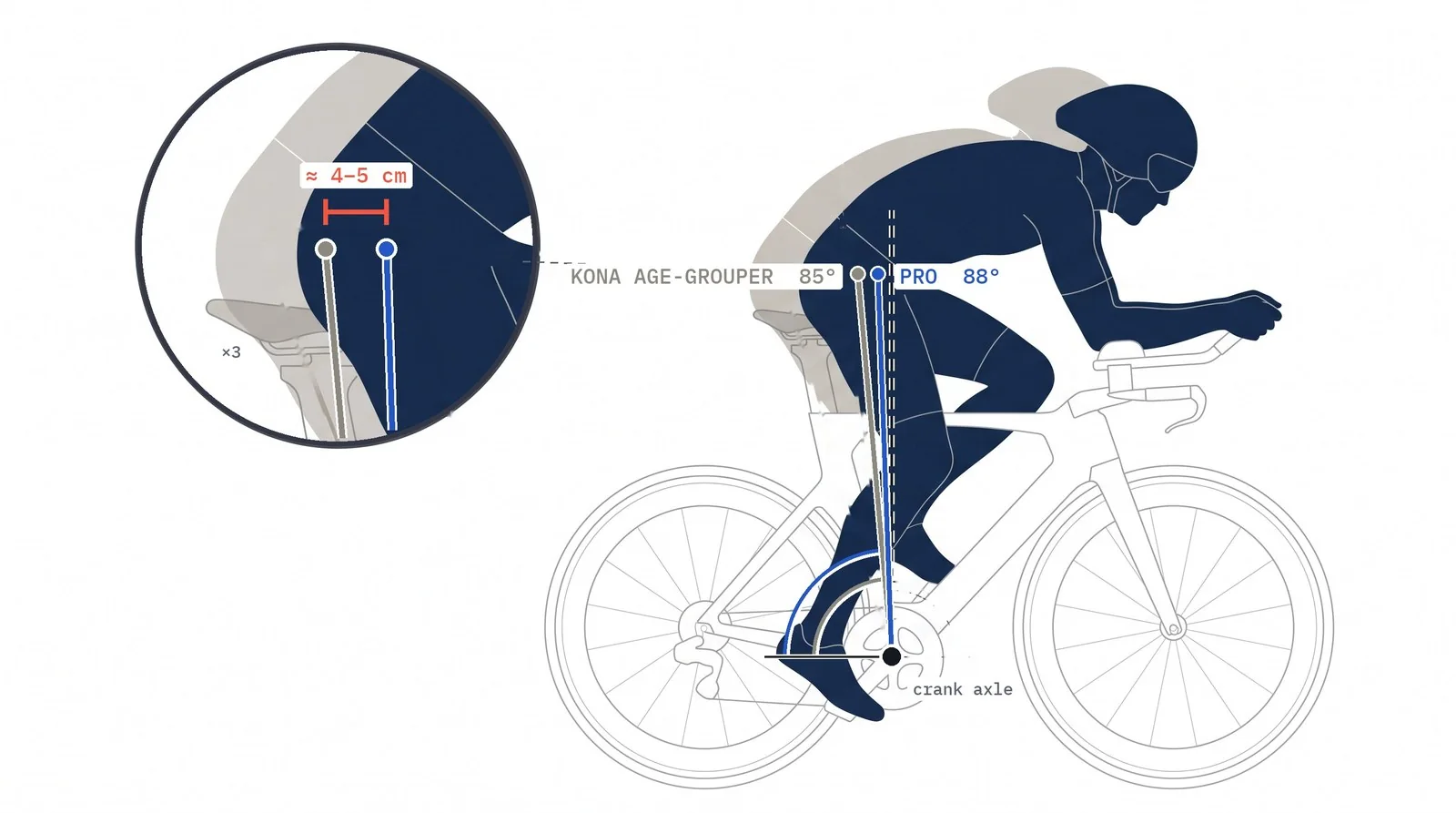
Kona pros and Kona age-groupers bend the knee the same: 145° and 146° at the bottom of the stroke. What separates them is where they sit. The pros' hips are 4–5 cm further forward over the crank.
That isn't where most age-groupers look. Ask what separates an age-group position from a pro's and you'll hear saddle height first, then how low the front end goes. Saddle height turned out to be a dead end. Position over the crank didn't.
- Knee: a tie. 145° for the pros, 146° for the age-groupers at the bottom of the stroke.
- Hip over crank: 88° against 85°. About 3°, which is 4–5 cm at the hip, for men and women alike.
- Torso: nearly 3° flatter on the pros, with the hip just as open at the top of the stroke as the age-groupers'.
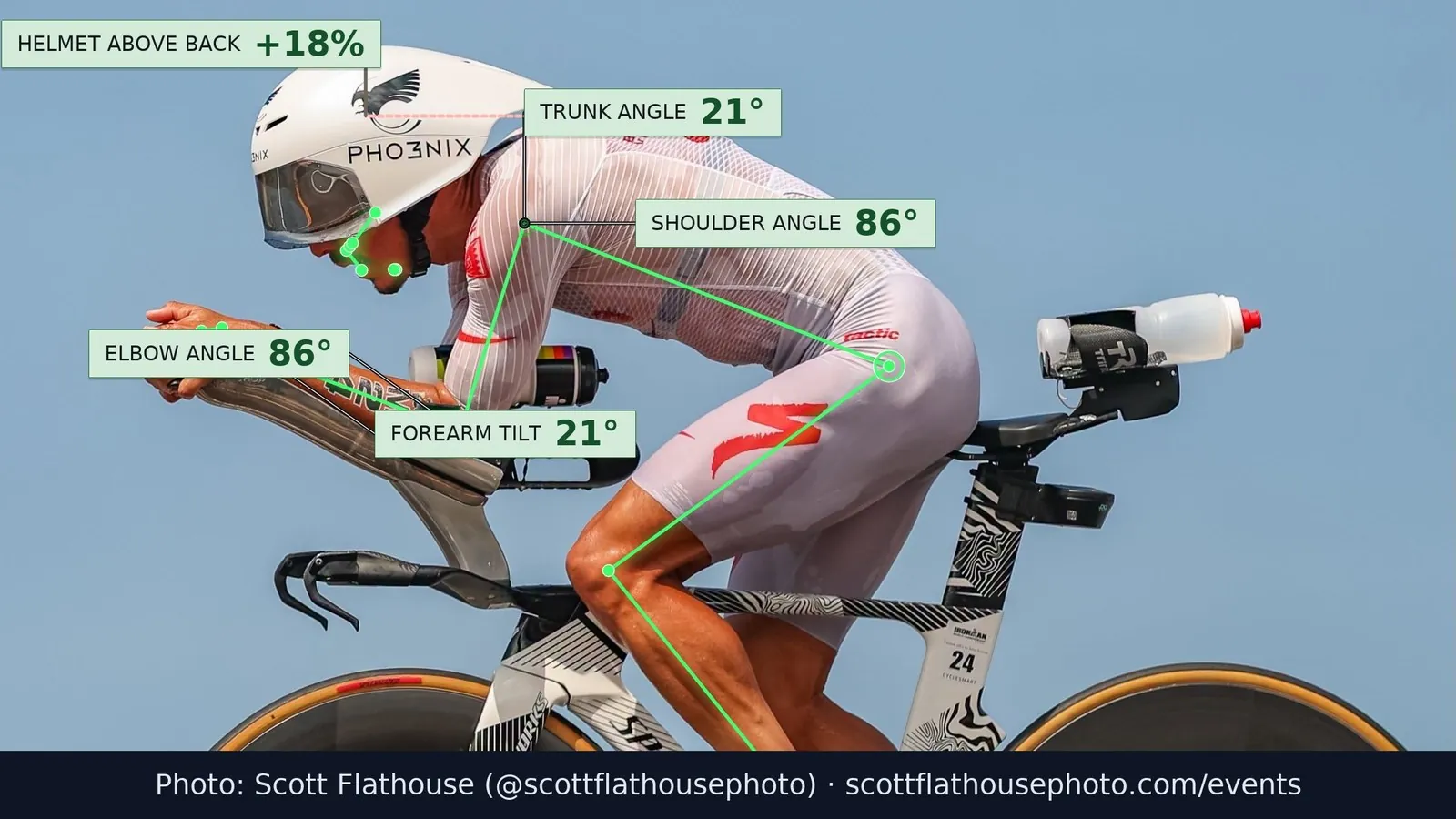
About the photos. All race photos here are by Scott Flathouse (@scottflathousephoto), Kona 2026, used with his permission. More of his Kona work: scottflathousephoto.com/events.
Pros sit 4–5 cm further forward
Hip over crank is the angle of a line from the crank axle to the hip joint, measured from the horizontal behind the rider: 90° puts the hip straight above the axle, and lower numbers mean the rider sits further back. Three degrees sounds like nothing, and at the axle it is. Up at the hip, about 83 cm away, it's 4–5 cm. In fit terms, that's a saddle roughly 4 cm further forward on its rails, or an effective seat angle about 3° steeper. Put another way, the typical pro's hip joint sits about 3 cm behind the crank axle and the typical age-grouper's about 7 cm. (The centimetres use a 170 mm crank as the ruler; shorter cranks shrink them a little. And because hip over crank is measured to the hip joint, not the saddle, it isn't the same number as a frame's seat-tube angle.)
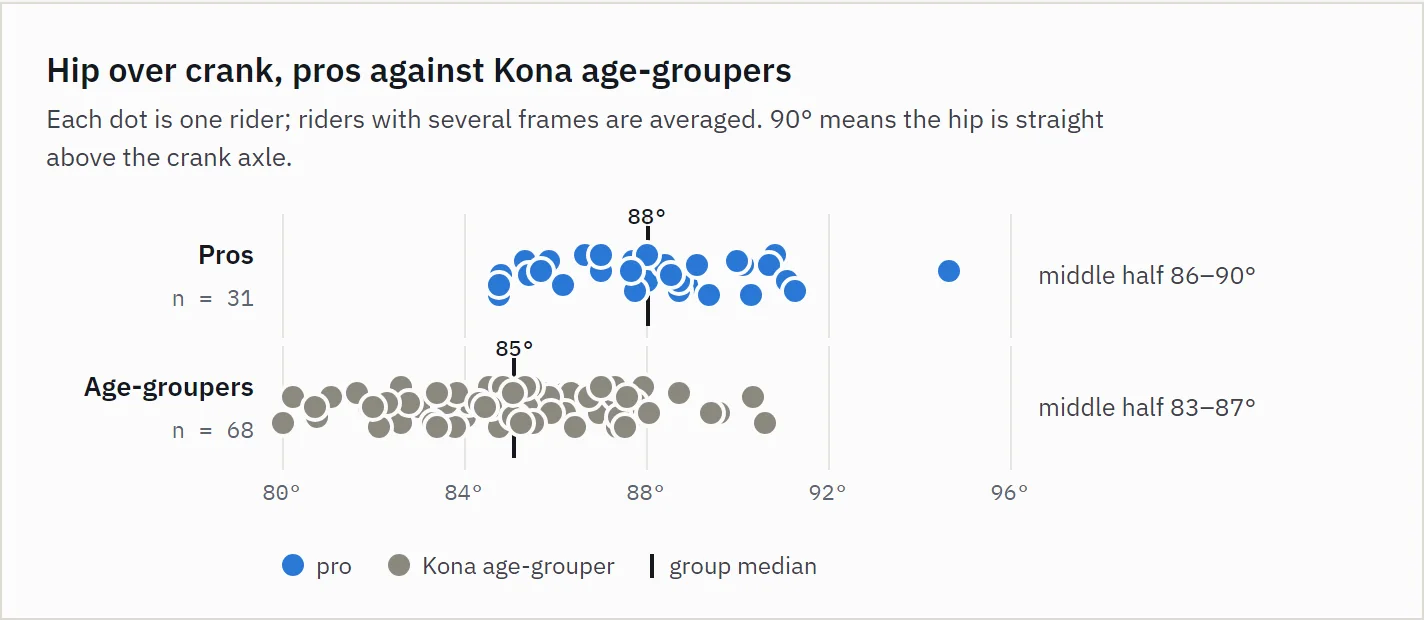
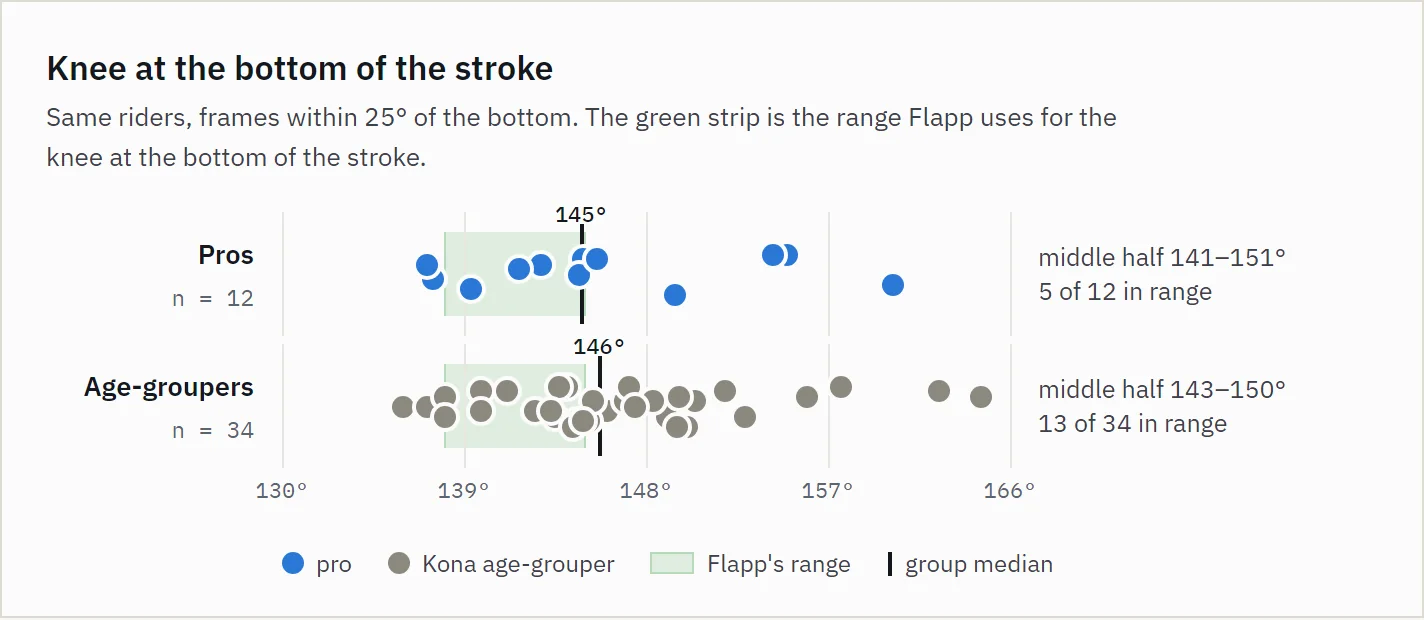
Same knee, different place to sit. The difference isn't saddle height.
| Measure | Pros | Middle half | Kona age-groupers | Middle half | Difference (95% interval) |
|---|---|---|---|---|---|
| Hip over crank | 88° | 86–90° | 85° | 83–87° | +3° (2–4°) |
| Knee at the bottom of the stroke | 145° | 141–151° | 146° | 143–150° | −1° (−5 to +5°) |
| Hip angle at the top of the stroke | 56.5° | 53–58° | 54° | 50–57° | +3° (−1 to +7°) |
| Torso, from horizontal | 21° | 19–24° | 24° | 21–27° | −3° (−4 to −1°) |
Men and women sit the same way
Women are 39% of our pros and about a third of our age-groupers, so it's fair to ask whether the gap is really a men-versus-women gap. It isn't. Inside each group, men and women sit within a degree of each other (0.7° among the pros, 0.8° among the age-groupers, neither clear of noise), and the pro gap shows up in each on its own.
| Hip over crank | Pros | Kona age-groupers | Difference (95% interval) |
|---|---|---|---|
| Men | 88.0° (19) | 85.3° (45) | +3.0° (1.7–4.5°) |
| Women | 88.6° (12) | 84.8° (22) | +3.4° (1.6–4.8°) |
Three of each
About the examples. These six frames are only an illustration: three of the 31 pros and three of the 68 age-groupers, picked by hand from riders close to their group's median. Every conclusion comes from the full sample, the charts and tables above. The age-groupers' faces and race numbers are blurred.
The white dashed line is vertical through the crank axle; the blue line runs from the axle to the hip. Knee and hip are graded only near the top or bottom of the stroke; mid-stroke they're shown in grey.
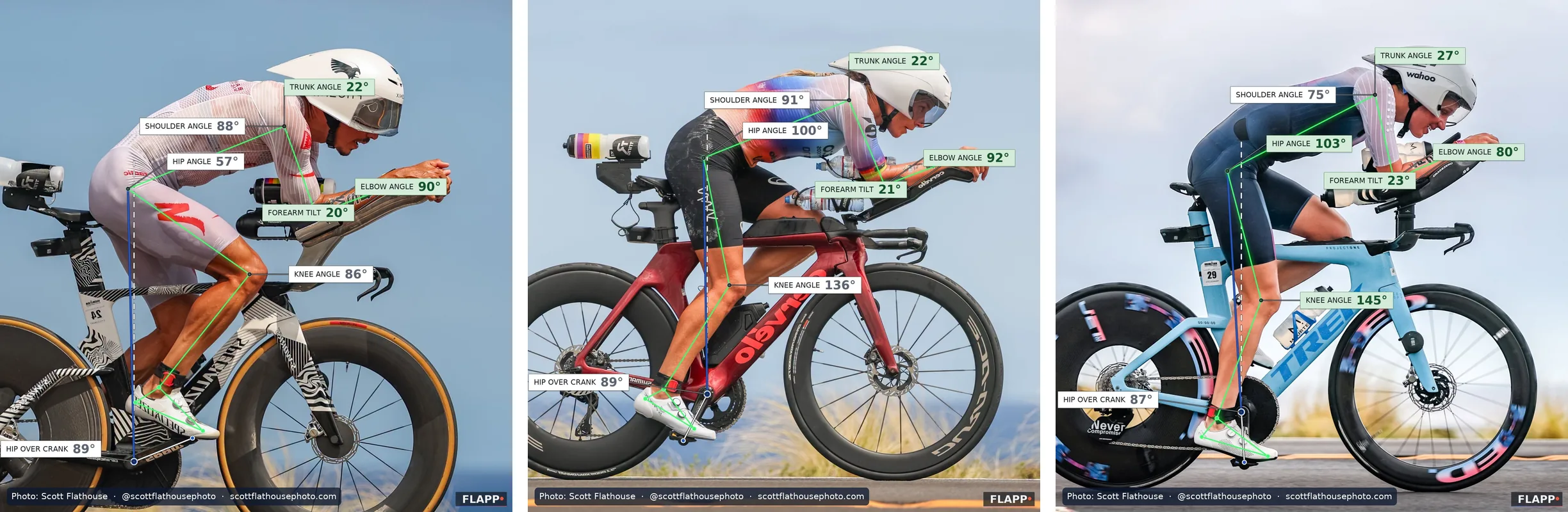
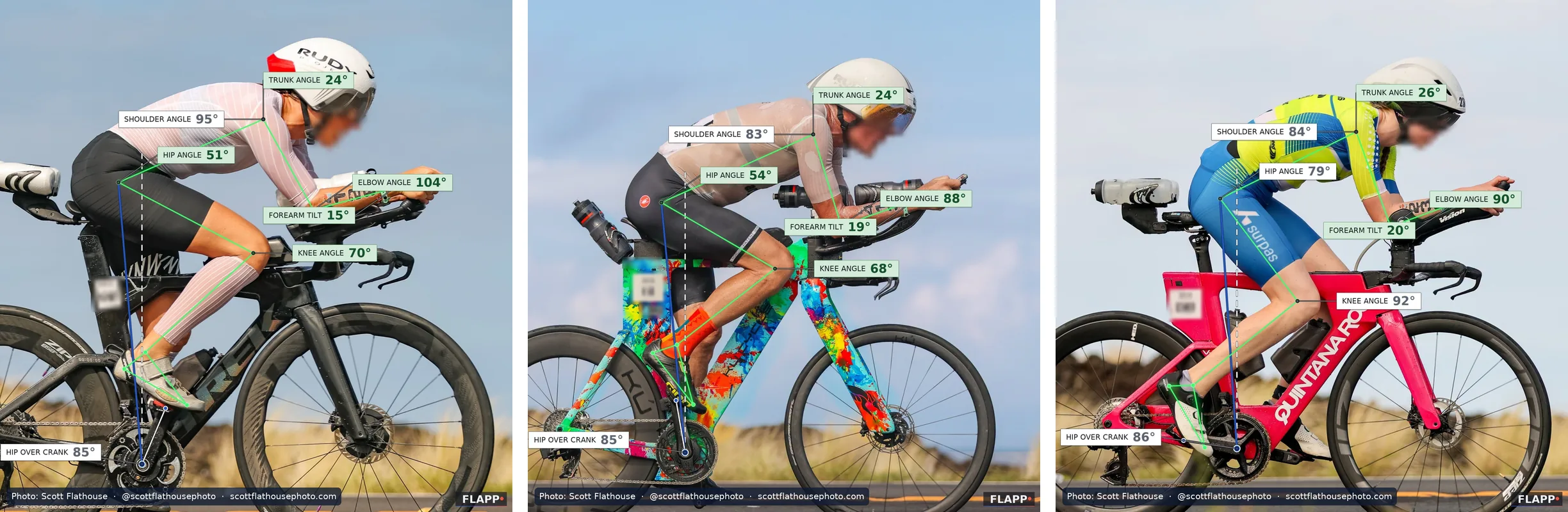
What it looks like on the bike
Rotate a whole rider forward around the crank axle and three things happen at once: the hip moves forward, the torso gets flatter, and the angle at the hip stays where it was. That's what the pros look like next to the age-groupers. Their torso is a couple of degrees flatter, and their hip stays just as open at the top of the stroke.
Where this fits
Mat Steinmetz saw this from the fitter's side last year. Going through Kona pro photos for Slowtwitch, he found most pros riding steep, saddles pushed forward, and he judged it by where the hips sit relative to the bottom bracket. He didn't put a number on it, and he wasn't comparing anyone with age-groupers. That's what these photos add.
Why pros sit there
Nobody gets told why with their race number, but the usual two reasons hold up.
- Aerodynamics. Rotating forward lets the torso come down without closing the hip, and a lower torso means a smaller frontal area. In Fintelman's measurements, dropping the torso from 24° to 16° cut frontal area from 0.335 to 0.318 m², about 5%. The pros' extra 2–3° is a slice of that, not all of it.
- The run. Eight triathletes ran 10 km more than three minutes faster after riding 40 km at an 81° seat-tube angle instead of 73° (Garside and Doran, 2000), and in a steeper position the calf and hamstring tended to work less (Bisi and colleagues, 2012), which may mean fresher legs off the bike. Both are small studies, and later work is mixed.
Good to know: these age-groupers are the elite. Everyone here qualified for Kona. We don't have hip-over-crank data for everyday riders yet.
Good to know: forward isn't free. It changes reach and puts more weight on the arms. It's a change to make with a fitter, not by sliding the saddle on race week.
Check your own
This measurement is now in Flapp. Film yourself side-on, photo or video: Flapp finds the crank axle and the hip on its own, works out your hip over crank and shows where you sit against the Kona pros (86–90°) and the Kona age-groupers (83–87°), in degrees and in centimetres. Try it in Flapp.
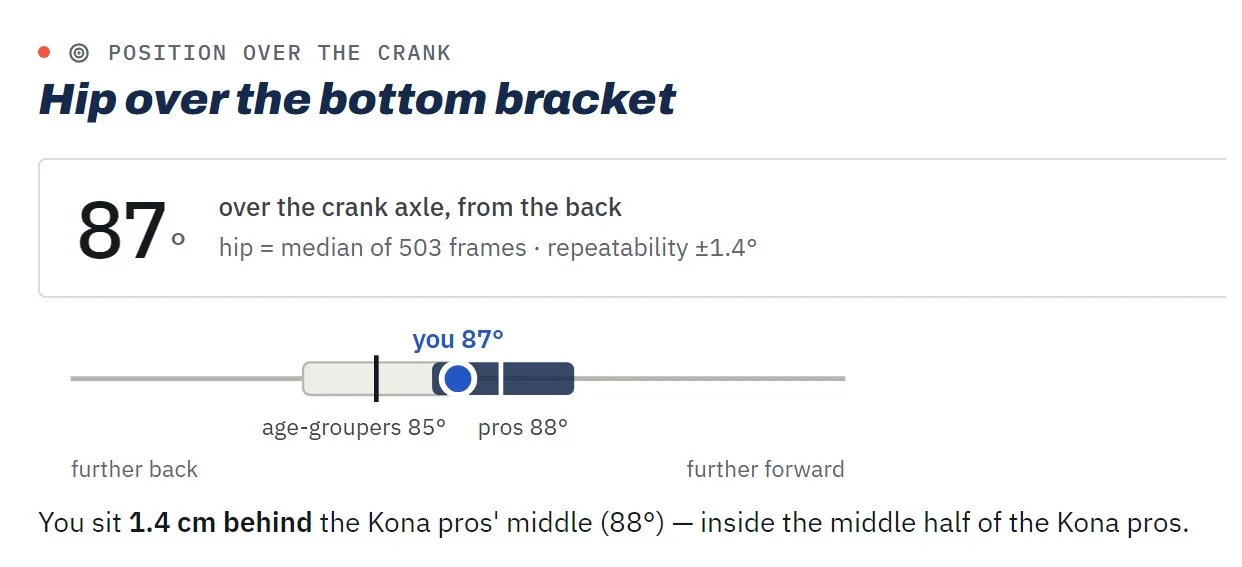
Check your hip over crank before you touch your saddle height. If it reads 85°, you're sitting where the Kona age-groupers sit, not where the pros do.
How we measured
We build Flapp, an app that measures a rider's position from a phone video or photo, and the whole study was run in it. We took 39 frames of 31 pros and 71 frames of 68 age-groupers from Kona 2026, only those shot side-on. Most are store previews; 16 are Scott Flathouse's full-resolution originals, and on those alone the gap comes out the same way, about 2.5°.
Every frame went through Flapp's pose model. It finds eight points on the side of the body nearest the camera (shoulder, elbow, wrist, hip, knee, ankle, heel and toe) and works out the angle at every joint. In Flapp's point editor we went through each frame, confirmed the points and added two on the bike: the crank axle and the near pedal axle. The line between them shows where the crank is, so Flapp knows the pedal phase on every frame.
Knee and hip angles depend on where the crank is, so we took them only from frames within 25° of the top or bottom of the stroke. Hip over crank barely depends on the crank position, so every frame counts for it.
Also on Kona 2026: what 32 pro bike positions actually measure.
Sources
- Steinmetz, M. (2024). Aero Evolution: Kona Pro Bike Positions (Slowtwitch, 25 November 2024)Most Kona pros rode steep, saddles pushed forward, judged by where the hips sit relative to the bottom bracket; no angles were measured.
- Fintelman, D. M. (2015). Influence of cycling position and crosswinds on performance and aerodynamics (PhD thesis, University of Birmingham)Frontal area 0.335, 0.318, 0.302 and 0.288 m² at torso angles of 24°, 16°, 8° and 0° (n=19).
- Bisi, M. C., Ceccarelli, M., Riva, F. & Stagni, R. (2012). Biomechanical and metabolic responses to seat-tube angle variation during cycling in tri-athletes (Journal of Electromyography and Kinesiology, 22, 845–851)Ten triathletes: no significant change in kinematics, oxygen uptake or muscle activation; a tendency to activate the calf and hamstring less in the steeper position.
- Garside, I. & Doran, D. A. (2000). Effects of bicycle frame ergonomics on triathlon 10-km running performance (Journal of Sports Sciences, 18, 825–833)Eight male triathletes rode 40 km at 73° and 81° seat-tube angles, then ran 10 km: 42:55 after 81° against 46:15 after 73°, most of the gain in the first 5 km.
Want this checked on your own form? Upload a side-view clip.
Analyze my video