Kona 2026: What 14 Pro Bike Positions Actually Measure
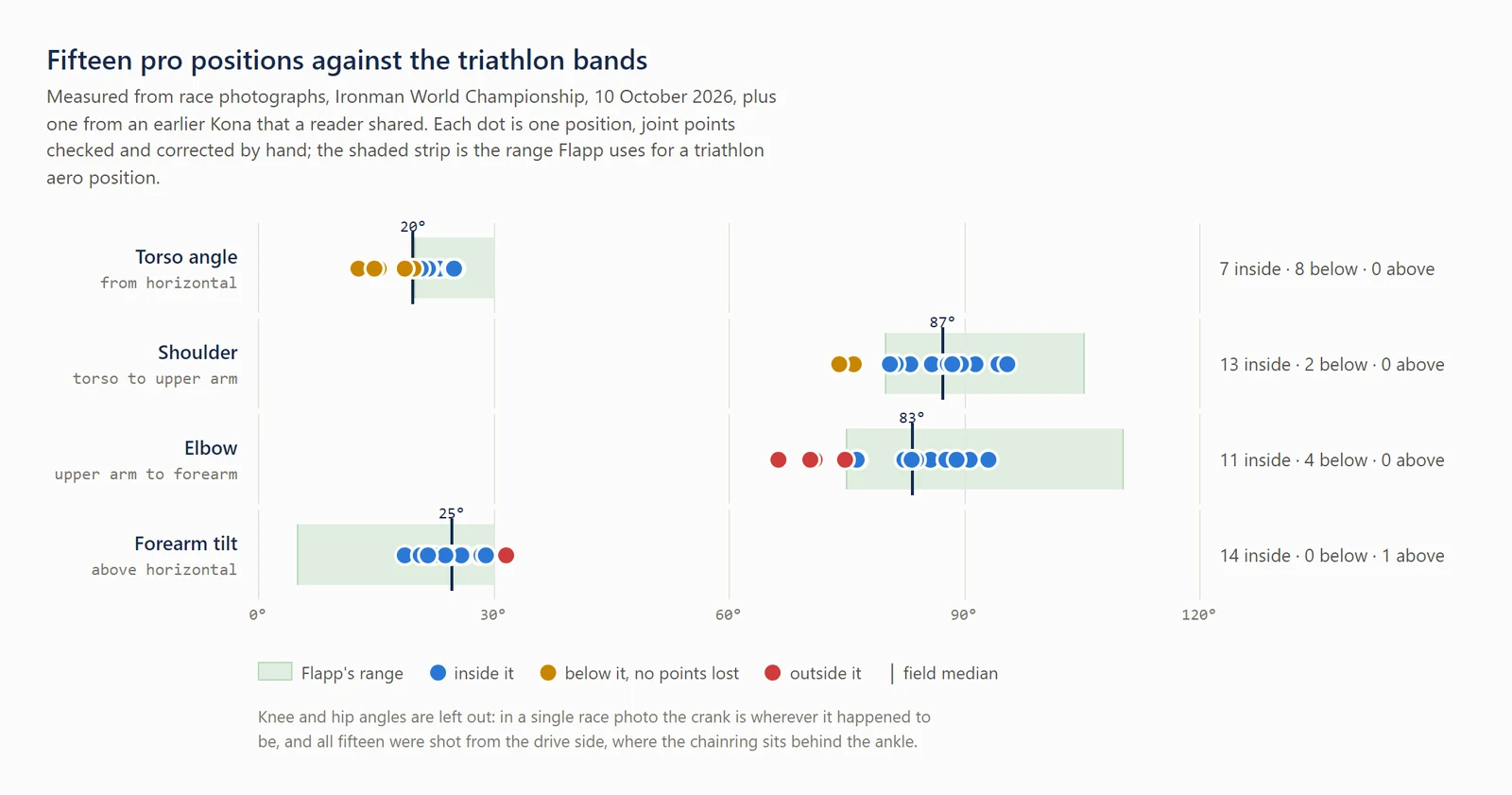
The day after the Ironman World Championship we ran fourteen professional bike positions, taken from race photographs, through the same pose model Flapp uses on your clips. The median pro rode with the torso 20° above horizontal, the upper arm at 85° to the torso, the elbow bent to 80° and the forearms tilted 25° up. Two of those four numbers sit at, or past, the edge of where most fit guidelines still put them.
The median Kona position
| Angle | Median | Middle half | Full range | Flapp's triathlon range |
|---|---|---|---|---|
| Torso, from horizontal | 20° | 17–24° | 12–32° | 20–30° |
| Shoulder, torso to upper arm | 85° | 77–88° | 71–97° | 80–105° |
| Elbow | 80° | 76–89° | 62–107° | 75–110° |
| Forearm tilt, above horizontal | 25° | 21–26° | 10–31° | 5–30° |
1. The hands have gone up
In seven of the fourteen positions the forearms were tilted more than 25° above horizontal, and one passed 30°. Only two were under 15°. A few years ago a flat forearm was the default; at Kona it was the exception.
The rules moved first. From 1 January 2023 the UCI raised the maximum tilt of the armrests from 15° to 30°, and the field has filled that space. The aerodynamics followed: in a 2025 study that modelled one professional rider and checked the model in a wind tunnel, very high hands alone cut drag area by 3%. Combined with narrow elbows the saving grew to 7.7% for high hands and 11.2% for very high hands. Mat Steinmetz, a fitter who works with professional triathletes, describes the same change from the other side: 10–20° of bar tilt supports the upper body, relaxes the shoulders and makes a pocket for the head.
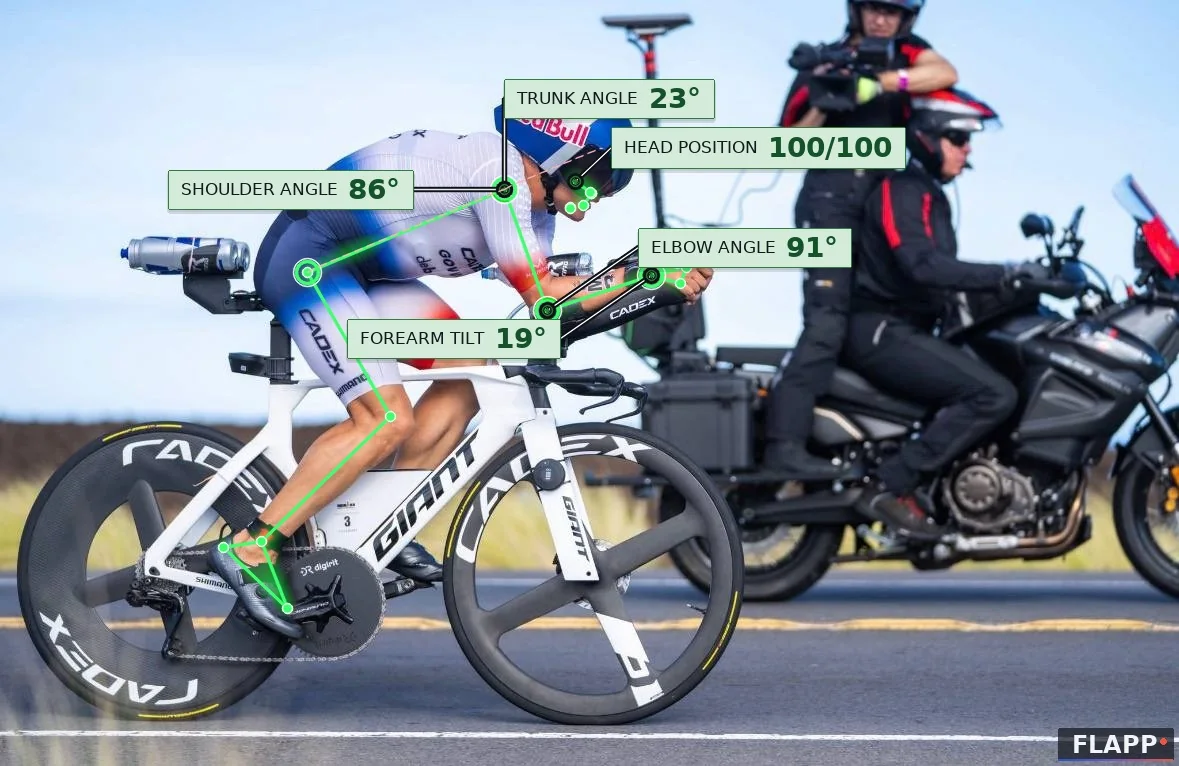
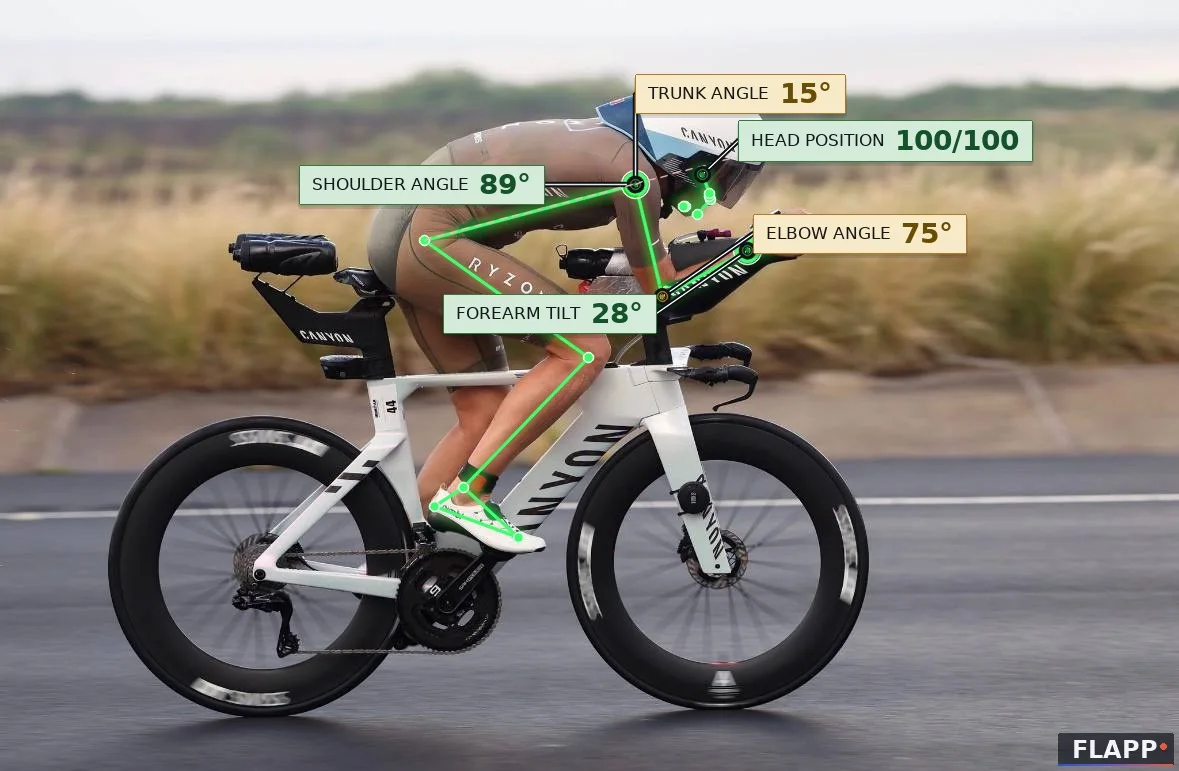
Two cautions. The saving is rider-specific, and the same study found that a smaller frontal area did not automatically mean less drag. And the elbow pays for it: when the hands rise, the elbow has to close. Across the field the two moved together more tightly than any other pair we measured (r = −0.76). Four riders sat below the 75° elbow floor in our own range. That floor was written for flatter forearms; we have not lowered it because we have not yet found a fitter or a study that names a lower number. If you ride tilted extensions, read your elbow angle together with your forearm tilt, not on its own.
2. The torso is not as low as you would think
The median torso was 20°, and half the field sat between 17° and 24°. That is lower than most age-groupers ride, but it is not the flat back of a track pursuit. Steinmetz makes the same point: the pros' back angles have hardly changed in recent years. What changed is where the hands and the reach are.
There is a reason the back stops where it does. Fintelman's work on nineteen trained cyclists measured what a lower torso buys and what it costs. Going from 24° to 16° cut frontal area by about 5%, and going on to 8° cut about another 5%. But maximal power and every physiological variable fell as the torso dropped, and the flattest position was significantly worse than all the others. His models put the best torso angle around 17° for speeds between 32 and 39 km/h, and found that a fully flat back is never optimal.
Six of the fourteen positions were below 20°. Pros can hold that: years of conditioning, four or more hours at a time. Most age-group athletes cannot hold that and still make their power. Flapp does not take points for a torso flatter than the range on aero bars, but it says plainly that this is the trade, and that it only pays if you can still breathe, push and hold it late in the race.
3. A closed shoulder is a choice, not an error
In five of the fourteen positions the upper arm was closer than 80° to the torso, the lowest at 71°. Fit guidance still puts the reference at 90°: elbows under the shoulders. But the people who wrote that guidance never called less than 90° a fault. Dan Empfield's original description of the measurement says an angle below 90° is the athlete's personal choice, and that it is an angle opened past 90° that can become a problem. Fintelman's riders, in their own preferred positions, averaged 91° give or take 5°.
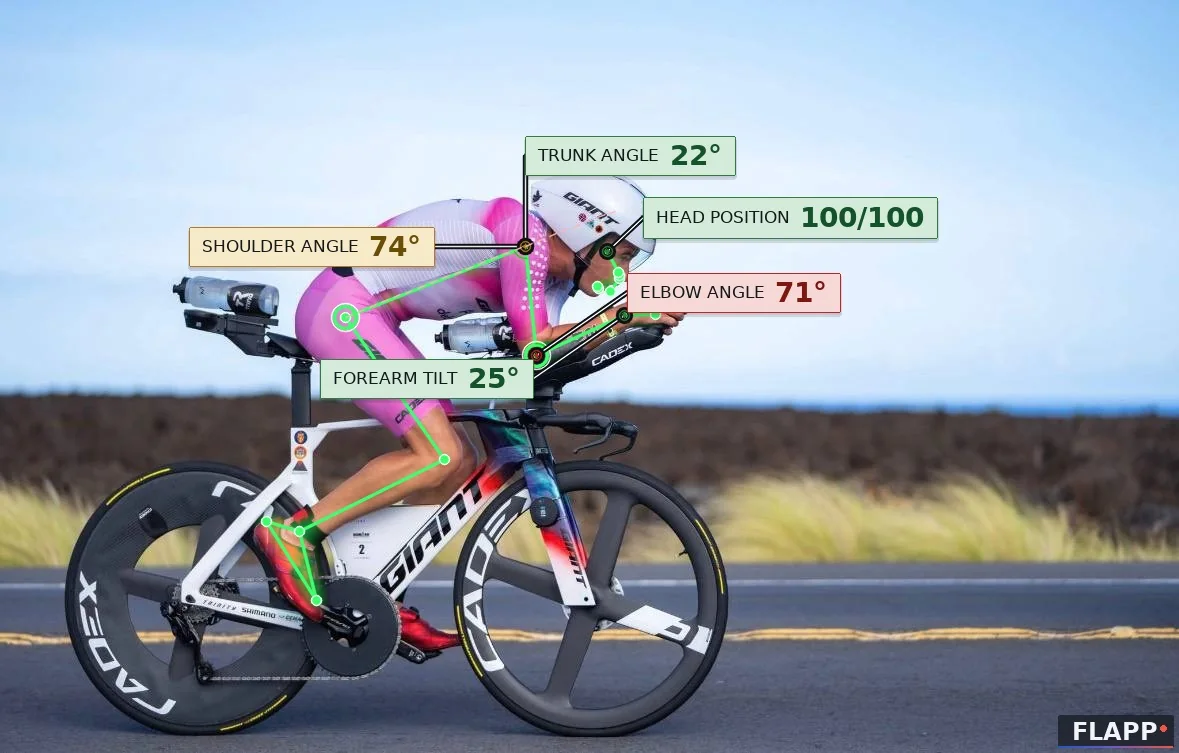
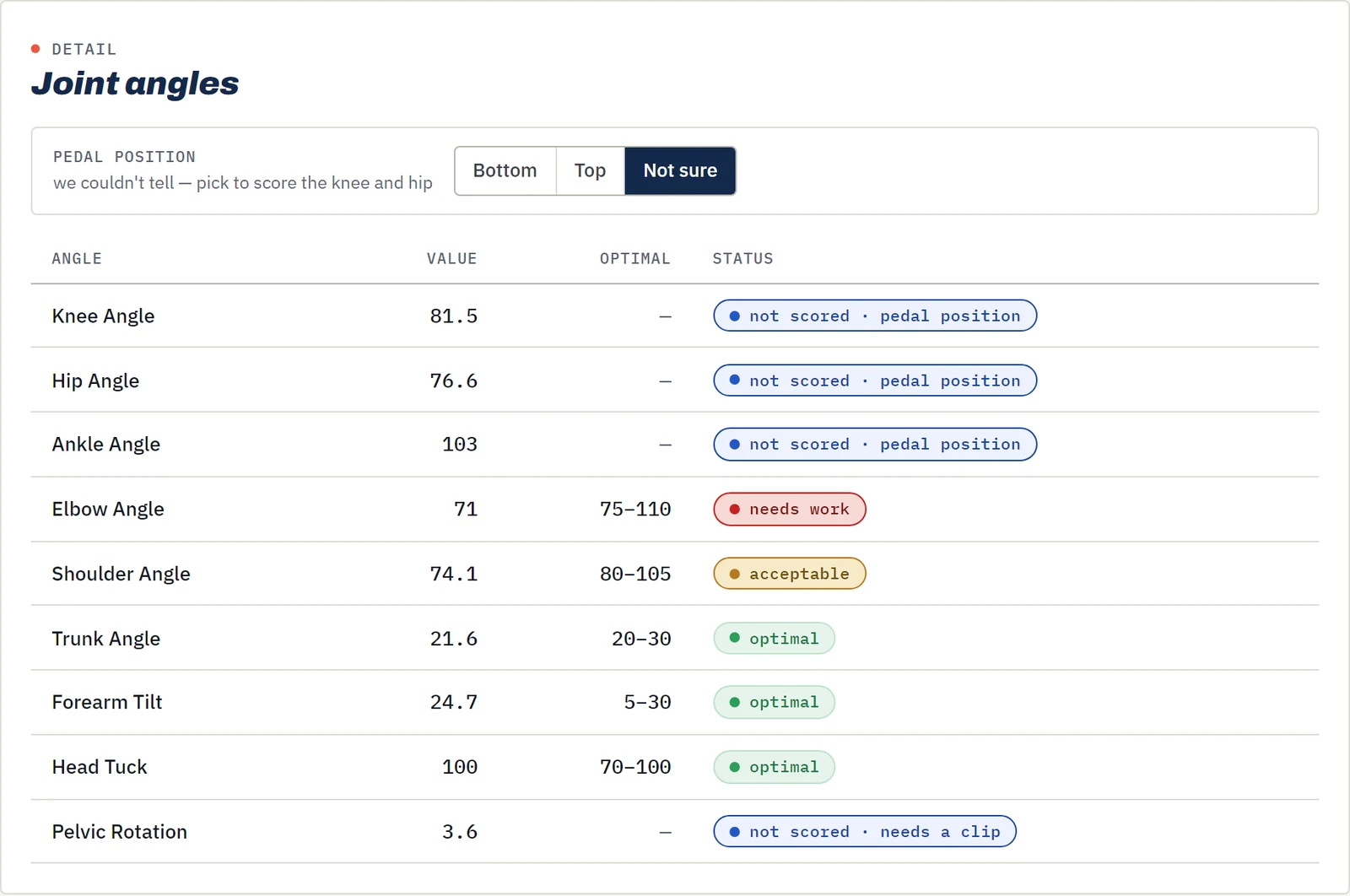
What to check if you ride like Rider C: whether the shoulders are shrugged up toward the ears, which is tiring and hard to breathe through, and whether the arms are carrying you or you are holding yourself up.
All fourteen positions
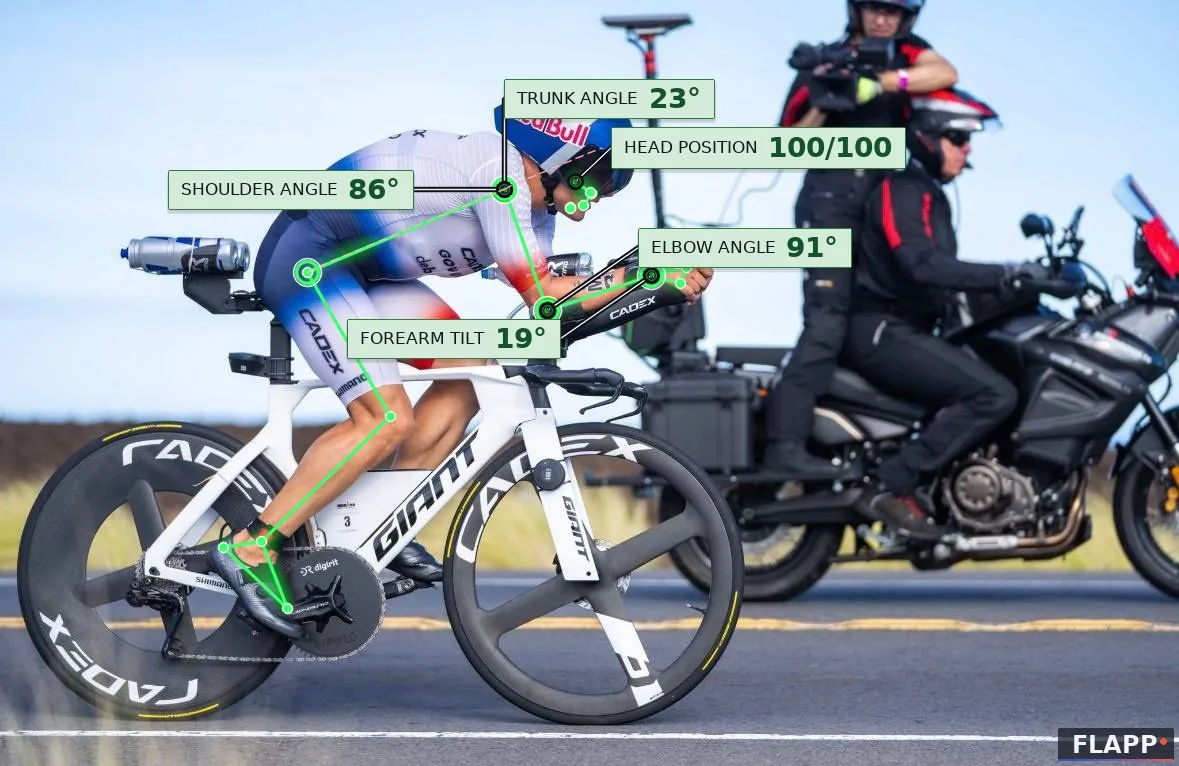
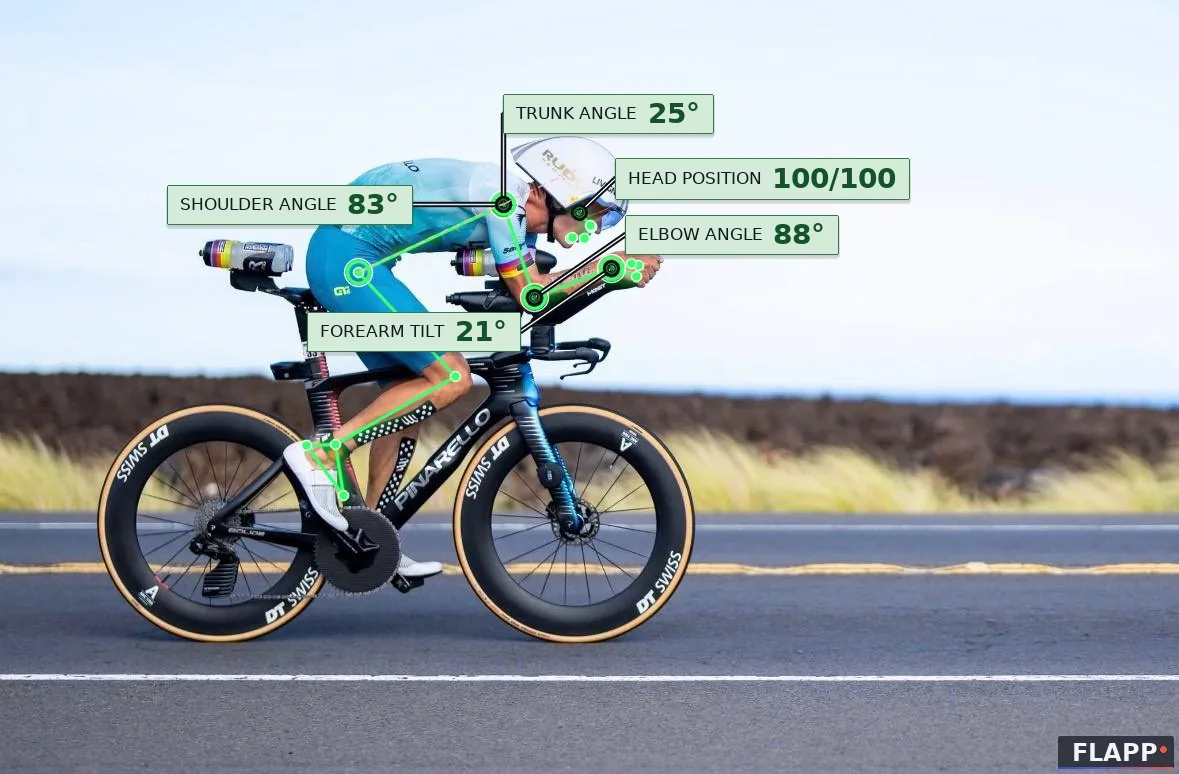
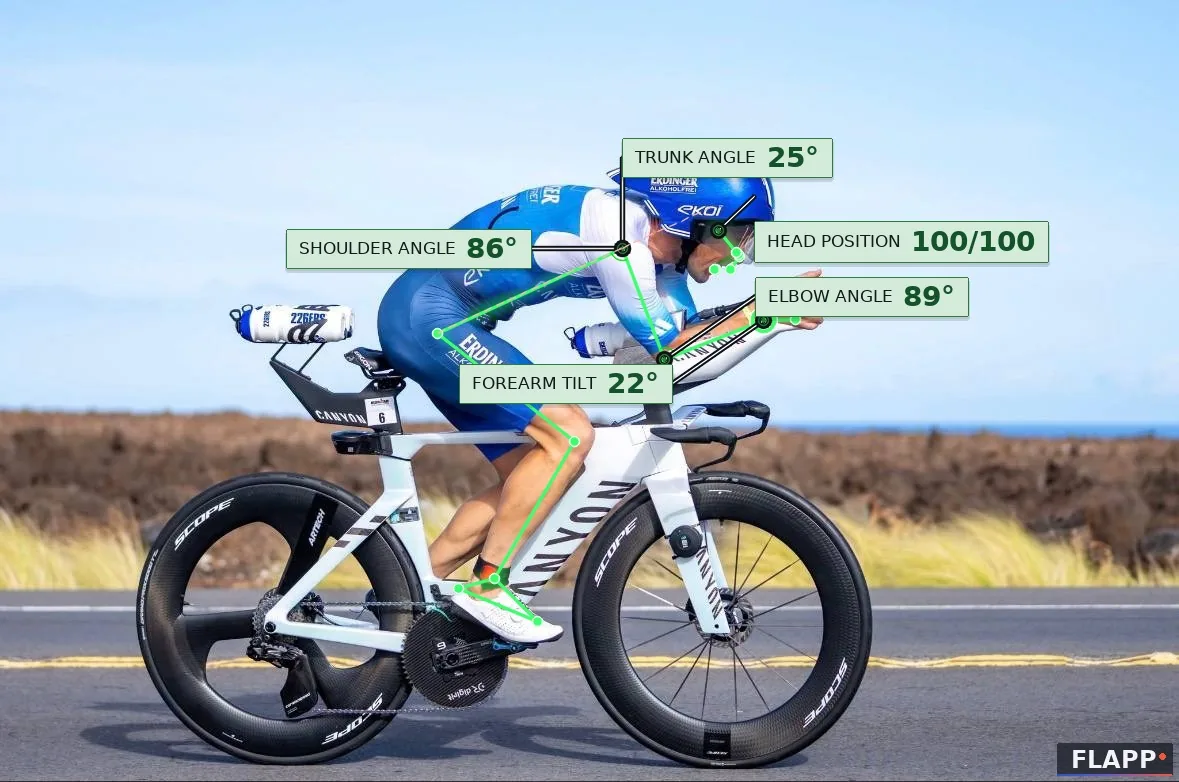
Every position we measured, ordered from the flattest forearms to the steepest. The labels are Flapp's own readings for a triathlon position: green inside the range, amber just outside it or below it at no cost, red outside it. Knee, hip and ankle are left off for the reasons in the next section.
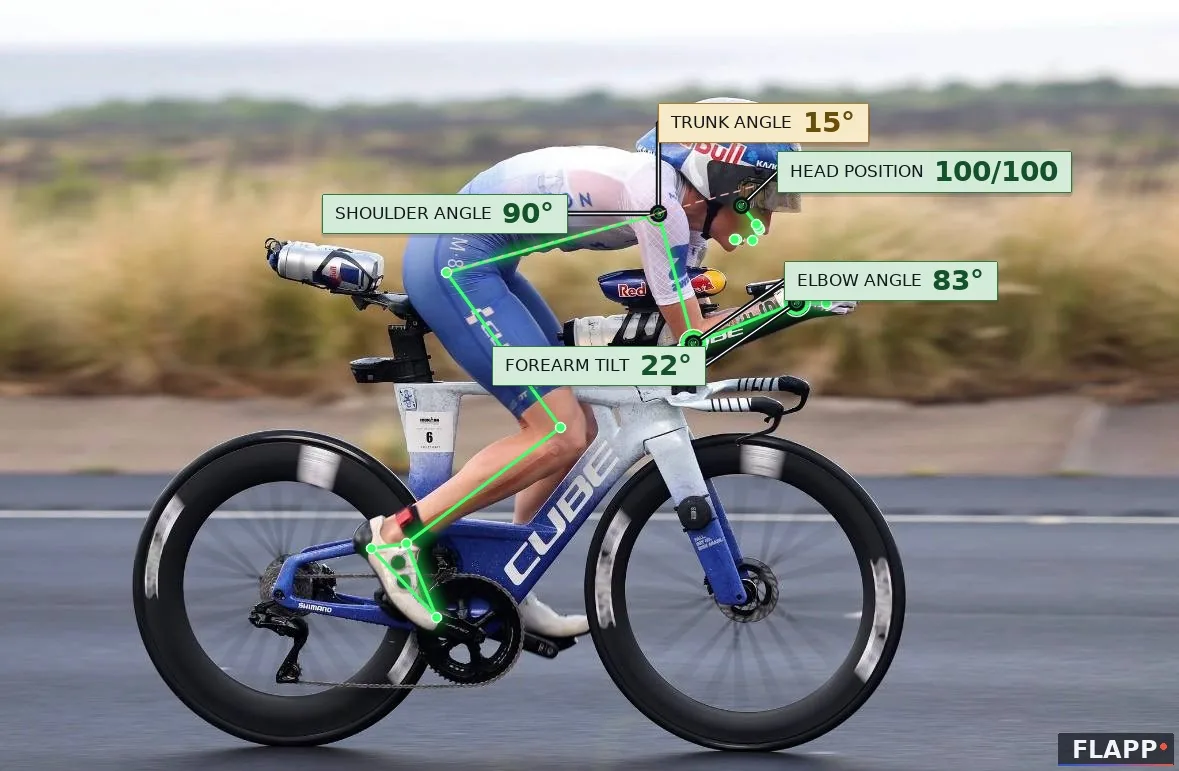
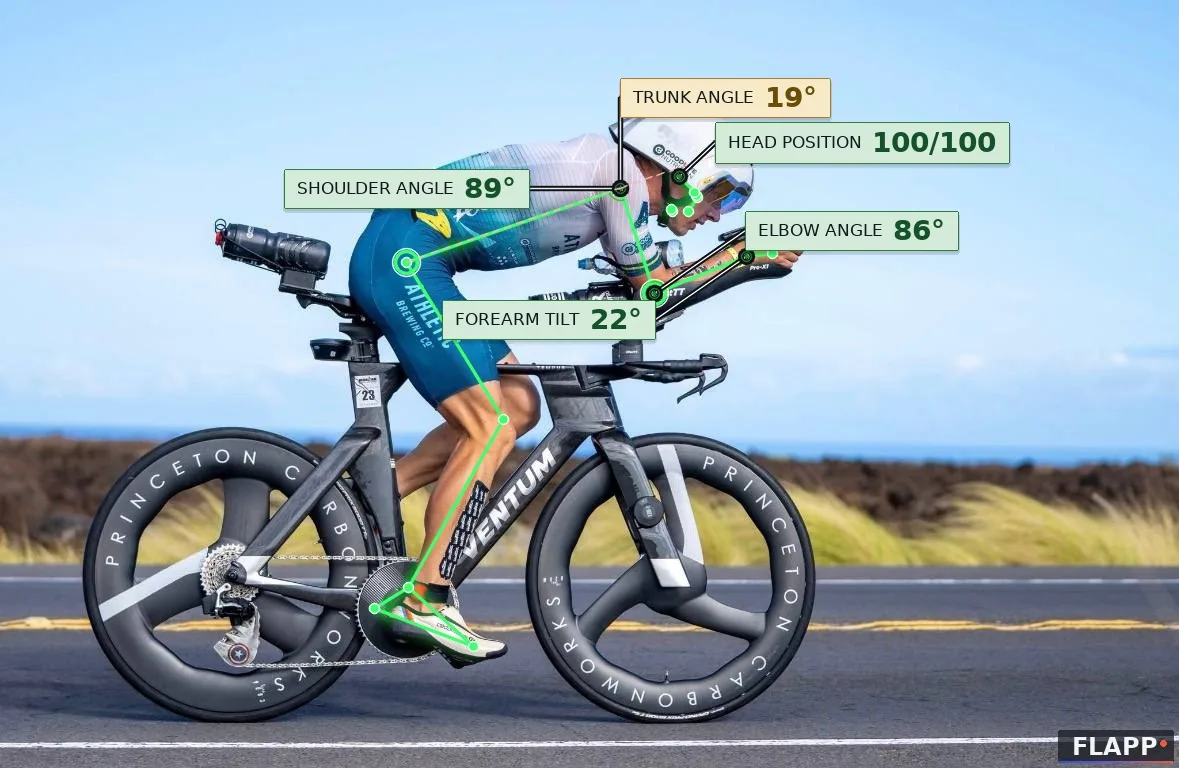
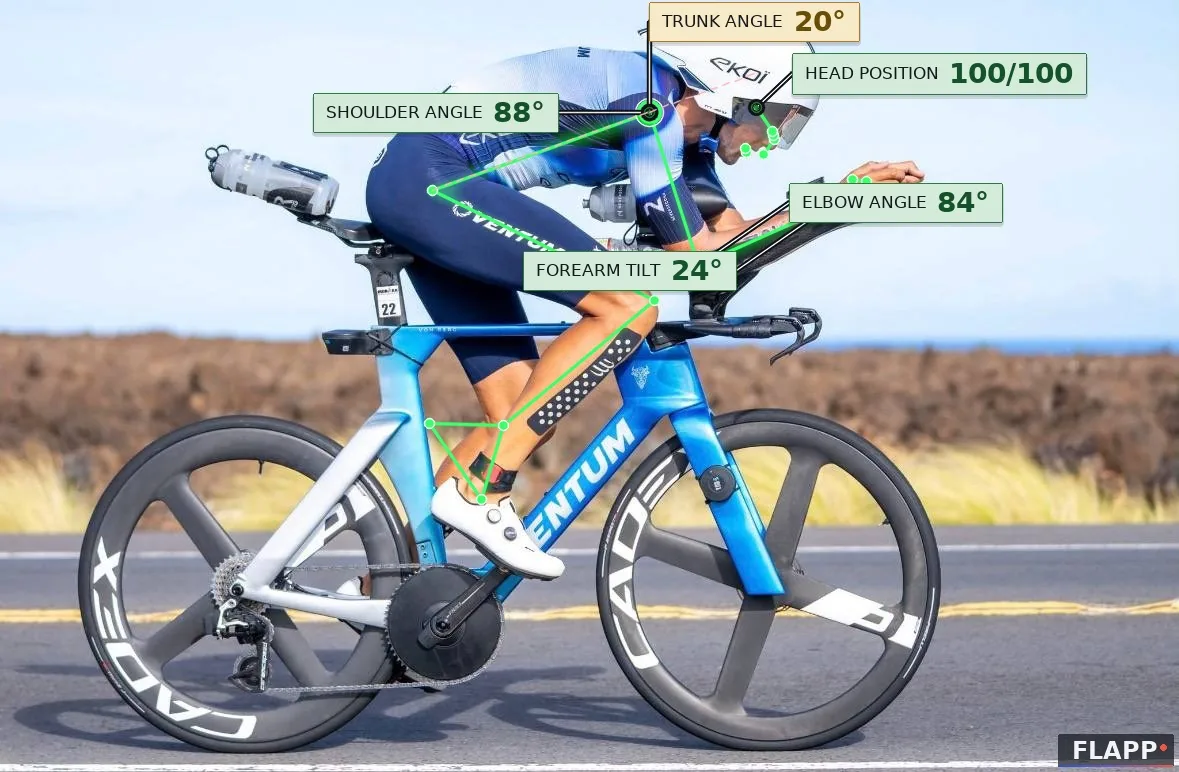
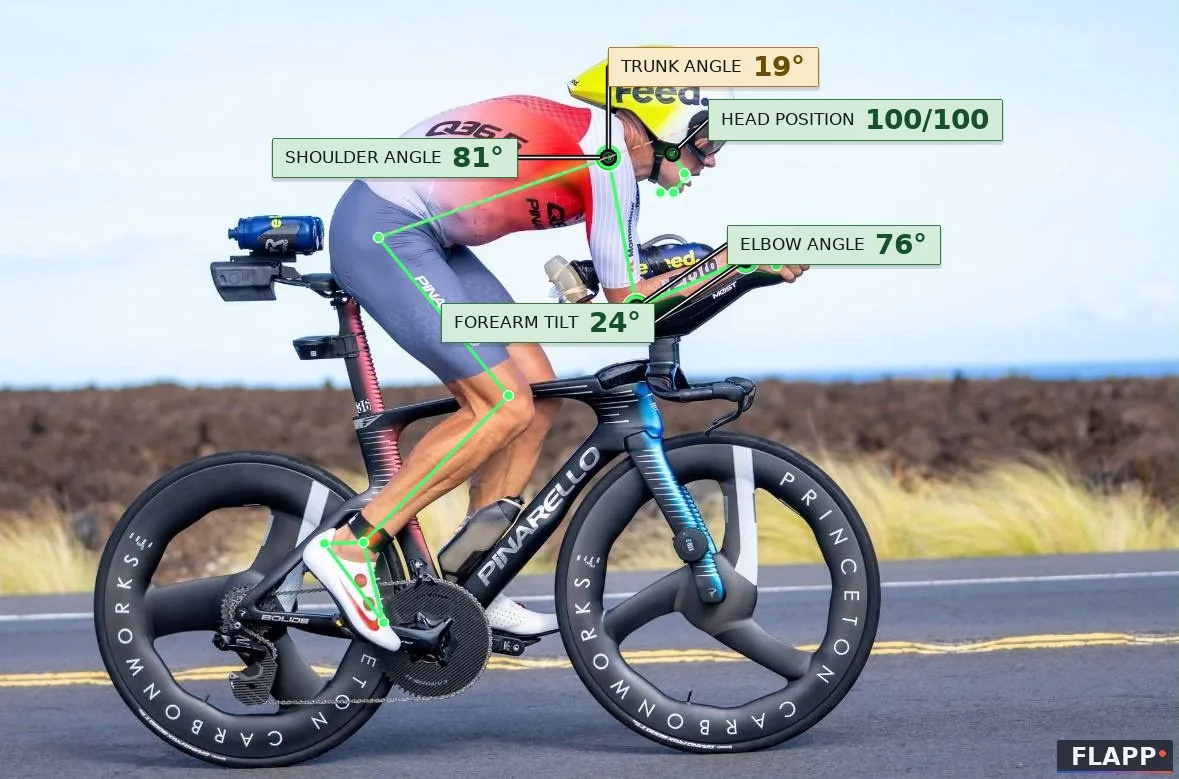
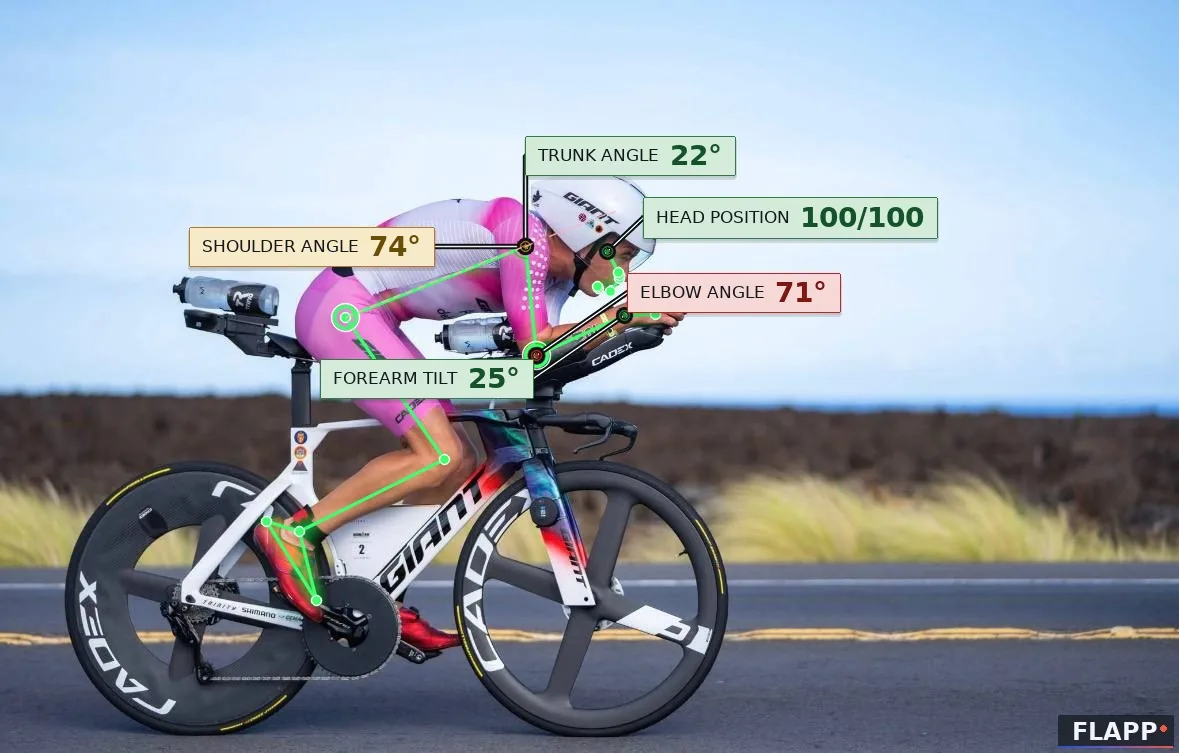
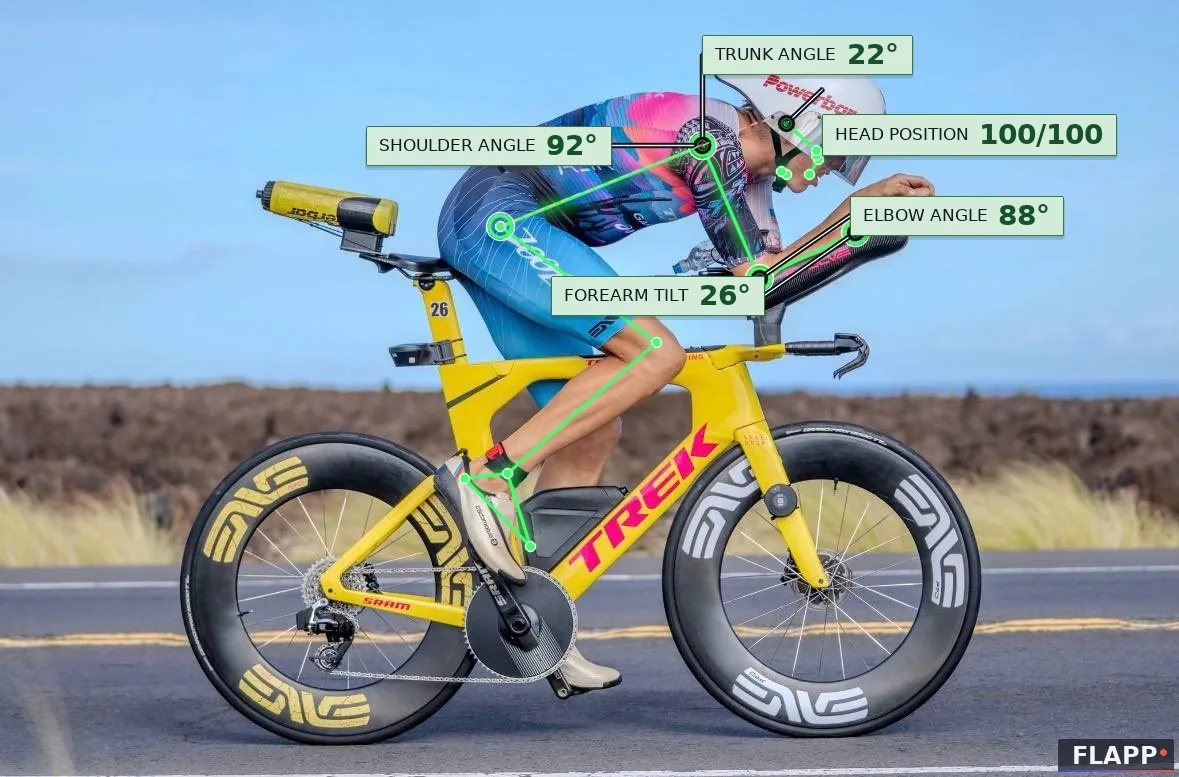
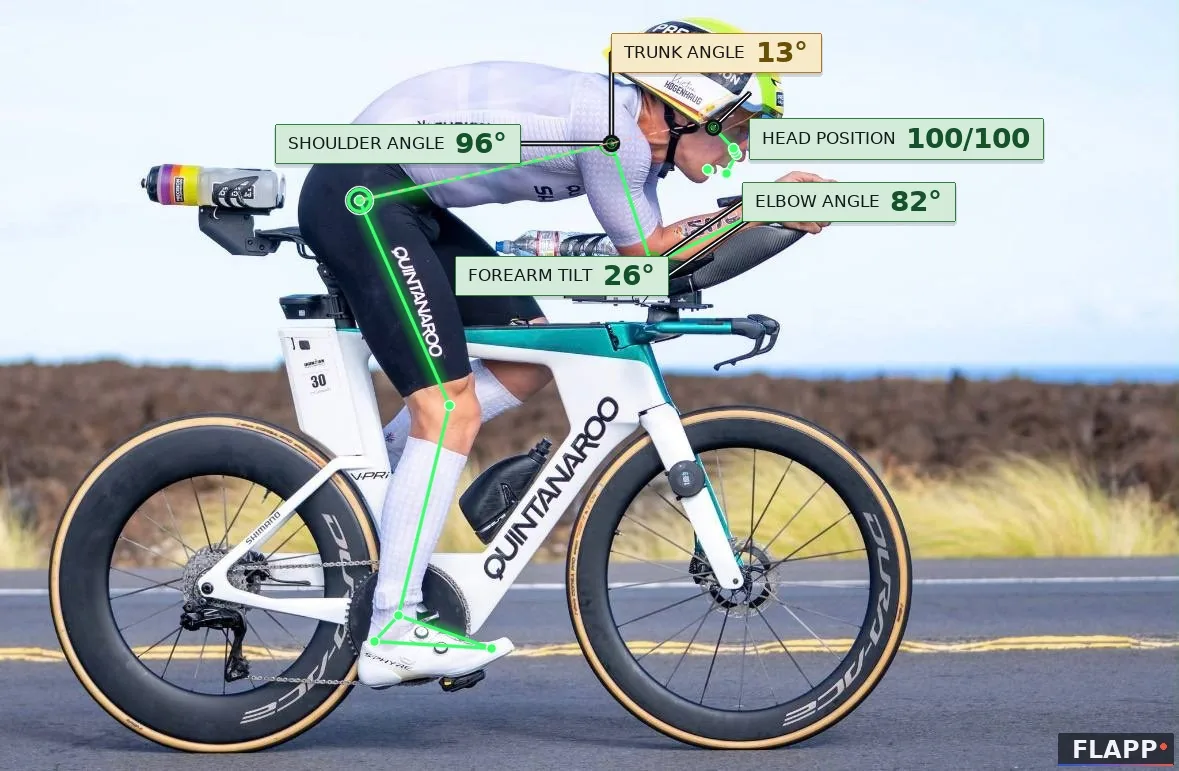
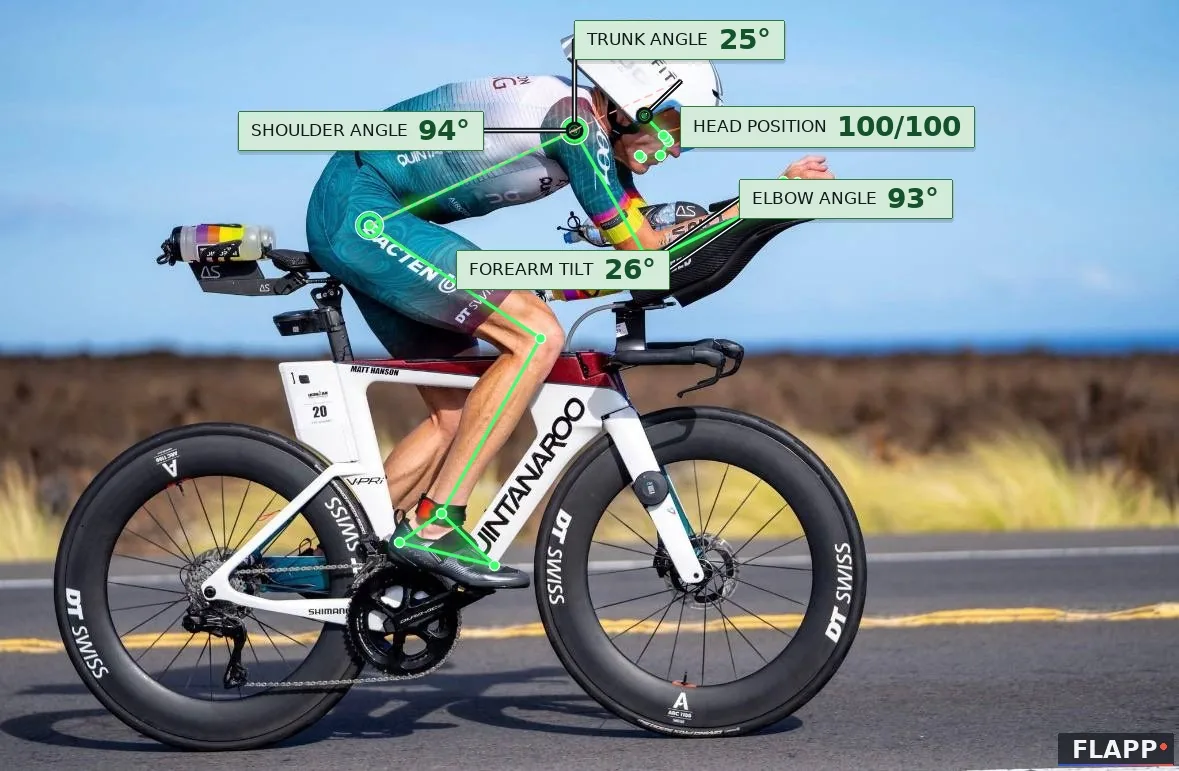
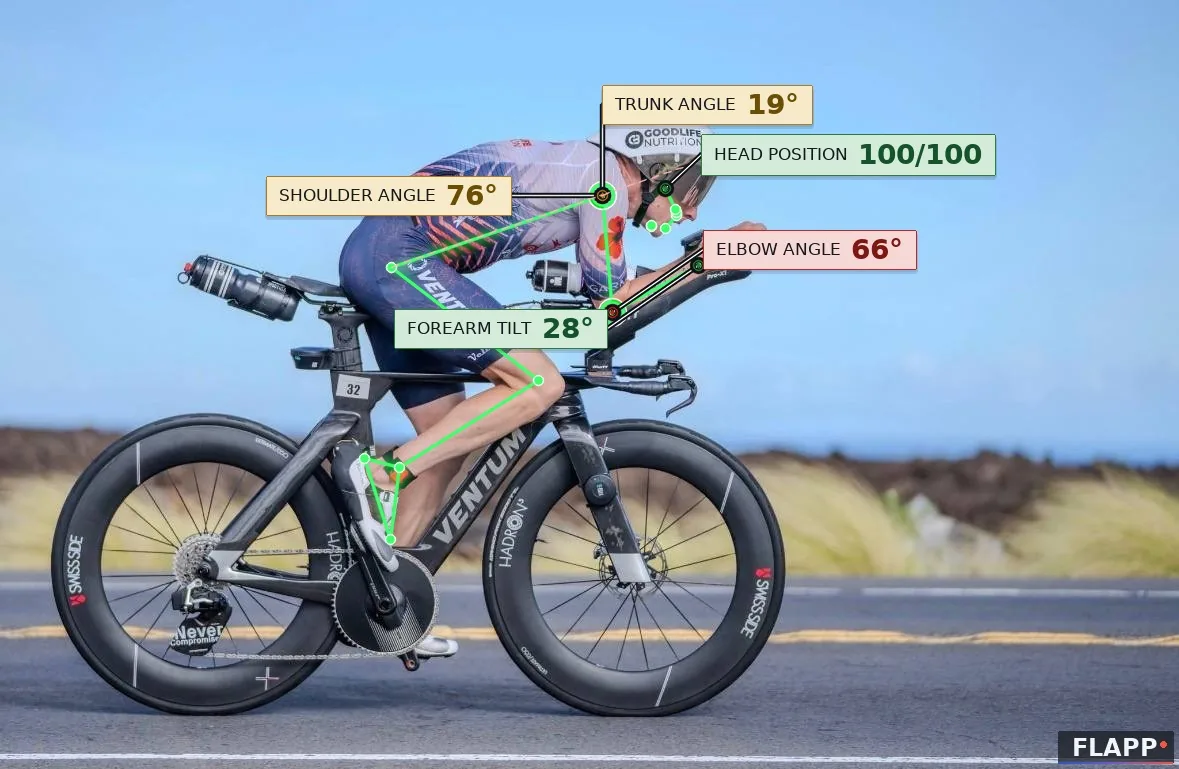
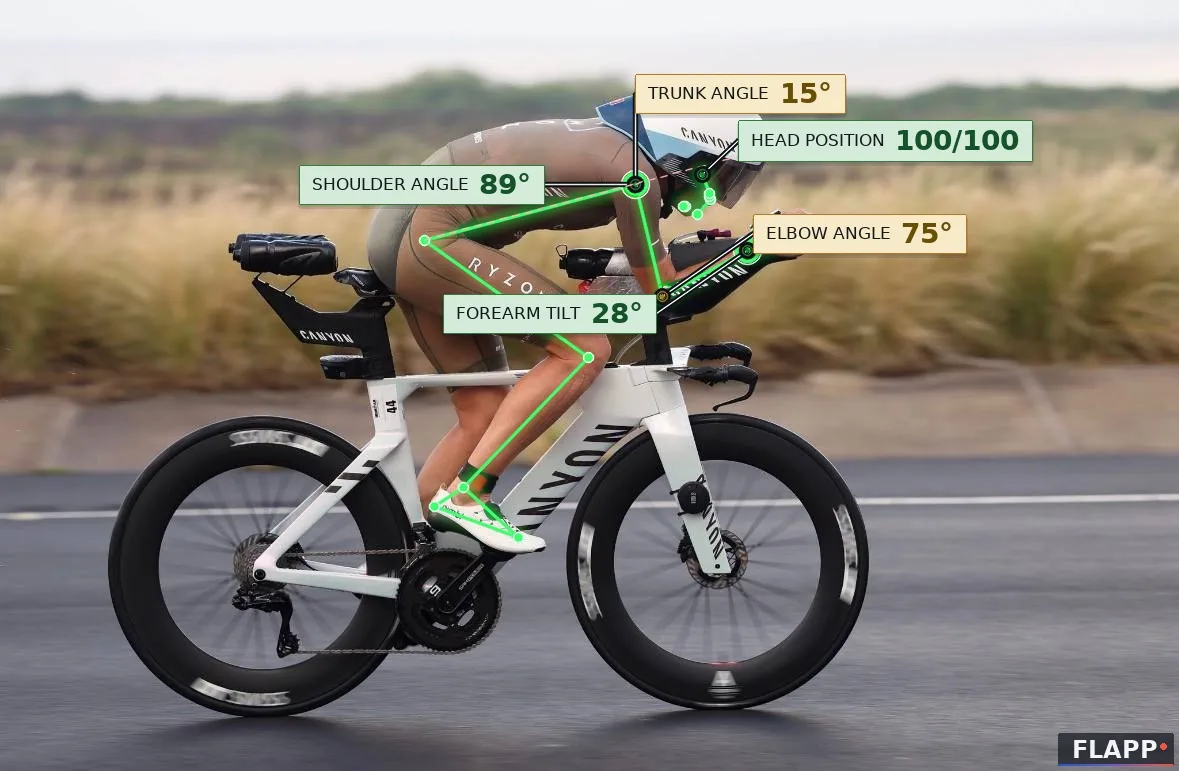
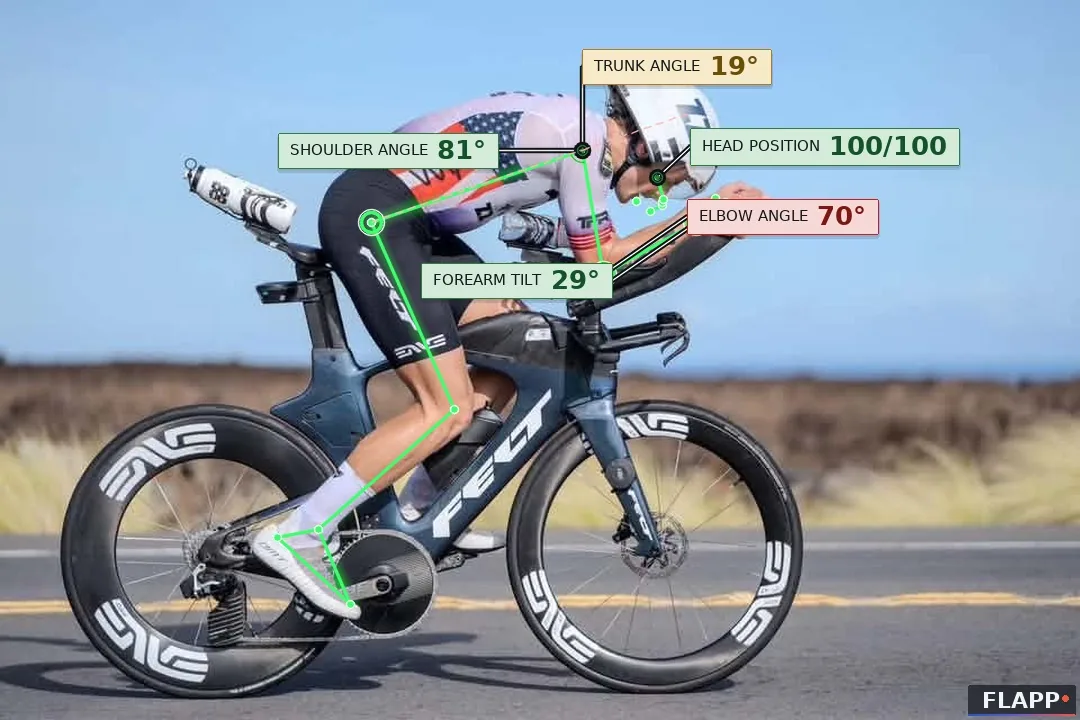
What we did not measure, and why
No knee angles and no saddle verdicts. In a single race photo the crank is wherever it happened to be, so the knee angle is not a saddle-height reading. There is a second reason. Every one of these photos was taken from the drive side, the side with the chainring, because the riders crossed the frame in the same direction past photographers on one side of the road. On two bikes of our own we measured that the drive side reads the knee at the bottom of the stroke 8–10° lower than it really is: the ankle point slides onto the dark chainring behind it. So we left the legs out rather than publish numbers we know are biased.
How we measured: fifteen photographs. One was rejected. The model had found the passenger on the camera motorbike instead of the rider, and Flapp returned no score rather than a wrong one. On the other fourteen, angles were measured in 2D on the side of the body nearest the camera. A pose model's points are its best guess at where each joint is, not the bony landmarks a fitter would mark by hand, so on any single photo a point can sit a couple of centimetres off, and that moves an angle by a few degrees: about 3° for a 2–3 cm miss. That is why we report the field rather than anyone's exact fit. Across fourteen positions those misses mostly wash out in the medians, and the differences that matter here, like the 15–20° spread in forearm tilt, are much bigger than that. Some athletes may appear in more than one photo; we could not check, so each photo counts as one position. The labels on the photographs are drawn by the same renderer the app uses on your own photos. In one photo, position 4, the model put the shoulder point on the top edge of the back instead of in the joint. We moved it down into the deltoid by hand, the way the app lets you correct a point, and the ring on that figure marks it; it changed that rider's torso from 39° to 30°. Every other point is the model's own. It is one race, one day and one roadside viewpoint, so read these as the shape of a field, not as anyone's exact fit. We do not name the athletes: we cannot verify who is in every frame, and the point is the position, not the person.
What to take for your own position
- Try some forearm tilt before you chase a lower torso. It is the trend with the best evidence, it is cheap to adjust, and 10–20° is where most of the field sat. Keep the elbows narrow; that is where most of the measured saving came from.
- Do not copy a 15° torso. Find the lowest angle you can hold for your race distance and still make your power, then test it in training at race effort.
- A closed shoulder is fine if you are not shrugging and you can breathe.
- Measure yourself the same way. Film from the side away from the chainring, camera at hip height, and include the bottom of the pedal stroke. Then you can put your own numbers next to the table above.
What we changed in Flapp
Measuring this field showed that three of our own rules were behind it, and we changed each one only as far as a source supports. The forearm-tilt range now runs to 30°, the UCI limit. A shoulder closed below the range on aero bars is amber and costs a third of the penalty, because no source calls it a fault. The aero estimate, which used to put every torso below 28° in one bucket, now separates three steps using Fintelman's measured frontal areas. And a torso flatter than the range costs no points, but comes with the concern you read above.
Sources
- Fintelman, D. M. (2015). Influence of cycling position and crosswinds on performance and aerodynamics (PhD thesis, University of Birmingham)Measured frontal area 0.335, 0.318, 0.302 and 0.288 m² at torso angles of 24°, 16°, 8° and 0° (n=19). In their own preferred positions the riders sat at a torso angle of 11.9 ± 5.6° and a shoulder angle of 90.7 ± 5.3°; a power-output model put the best torso angle near 17° at 32–39 km/h.
- Fintelman, D. M., Sterling, M., Hemida, H. & Li, F.-X. (2014). Optimal cycling time trial position models: aerodynamics versus power output and metabolic energy (Journal of Biomechanics, 47, 1894–1898)The optimal torso angle depends strongly on speed; aerodynamic losses outweigh power losses above about 46 km/h, and a fully horizontal torso is never optimal.
- Fintelman, D. M., Sterling, M., Hemida, H. & Li, F.-X. (2015). The effect of time trial cycling position on physiological and aerodynamic variables (Journal of Sports Sciences, 33, 1730–1737)Nineteen well-trained male cyclists at torso angles of 0, 8, 16 and 24°: maximal values of all variables decreased with lower torso angles, and the 0° position significantly affected the metabolic and physiological variables compared to all other positions.
- Maddocks, P. & Walker, A. D. (2025). Effect of arm position on the aerodynamic drag of an individual time trial position (Sports Engineering, 28, 11)On one professional rider, very high hands alone cut CdA by 3.0%; combined with narrow elbows, high hands cut it by 7.7% and very high hands by 11.2%.
- UCI (2023). UCI Regulations for road cycling: changes for time trials (in force as of 1 January 2023)The maximum inclination of the forearm support was raised from 15° to 30°.
- Steinmetz, M. (2024). Aero Evolution: Kona Pro Bike Positions (Slowtwitch)Pros are raising their front ends by an estimated 40–60 mm, extending reach by 60–100 mm and adding 10–20° of bar tilt; back angles have not changed significantly.
- Empfield, D. (2007). Cockpit length (Slowtwitch)A 90° torso-to-upper-arm angle is the reference; less than 90° is the athlete's personal choice, while an angle more obtuse than 90° can become an issue.
Want this checked on your own form? Upload a side-view clip.
Analyze my video