Running, treadmill, side view
A 9-second treadmill clip, framed so the athlete fills it. Every stride metric measured: cadence, ground contact, flight time, vertical oscillation and overstride, plus the five kinogram positions.
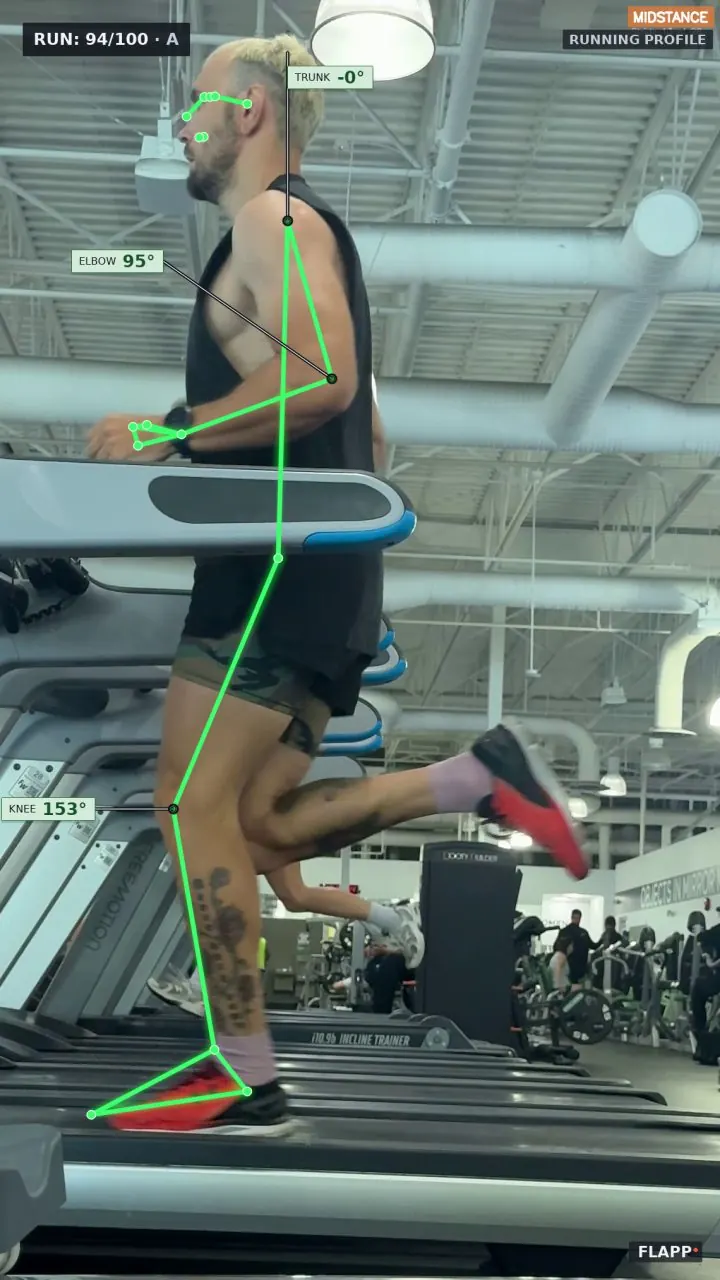
Scored on 9 of 9 measures — 100% of the rubric.
Measured against published ranges
Every target names where it comes from. A value a degree or two outside a band is inside the method’s own error, not a finding.
| Measurement | Yours | Reference | Source |
|---|---|---|---|
| Cadence | 170.3 spm | 170–190 spm | Heiderscheit 2011 |
| Trunk lean | 2.3° | -2–10° | Folland 2017 |
| Ground contact | 223.4 ms | 180–270 ms | Folland 2017 |
| Flight time | 120.3 ms | 80–150 ms | Weyand 2000 |
| Overstride | 0.3 × leg length | 0–0.1 × leg length | Heiderscheit 2011; Souza 2016 |
Findings
- overstriding — 0.34 x leg length ahead of hip
What to work on
- Quick-Feet Cadence Drill — Land under your body, not out in front -- shorter, quicker steps
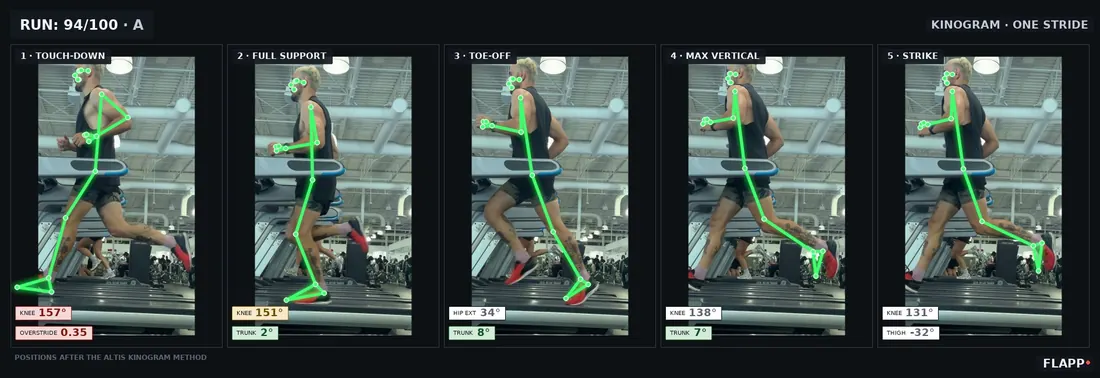
One stride, five positions
The ALTIS kinogram positions, found in the clip rather than posed — and published only when the analyzer trusts its own stride timing.
What the recording cost the measurement
Verdict: fair. Every analysis says how the clip limited it, and what to change next time.
| Check | Measured | Target |
|---|---|---|
| Needs attention: Telling your left leg from your right | legs confused on 10.3% of frames | under 5% — on a well-framed clip this sits near zero |
| Needs attention: How steady the camera was | camera moved 34% as much as your hips did (23.5 px) | under 15% — a camera on a tripod or a fence post reads near zero |
| Good: How much of the frame you fill | 908 px tall (71% of the frame height) | 550 px or more — roughly two thirds of the frame height |
| Good: The angle you filmed from | side on (depth ratio 0.683) | filmed square-on to your side, so the joints move across the lens |
| Good: Which way you held the phone | portrait (1140x2026) | portrait — a tall frame puts nearly twice the pixels on your legs |
| Good: How long the clip runs | 9.5 s | 5-10 s of steady movement |
Measured from a single side-on camera with 2D pose estimation. Only the near side of the body is measured; the far side is absent rather than assumed symmetrical. Reference ranges are efficiency targets from the literature, not diagnoses.
Film ten seconds and get your own
Side-on, phone upright, you filling the frame. Free account, no card.
Analyze your form — free