New York's Winner Lands Half a Leg in Front of His Hips. That Isn't the Fault.
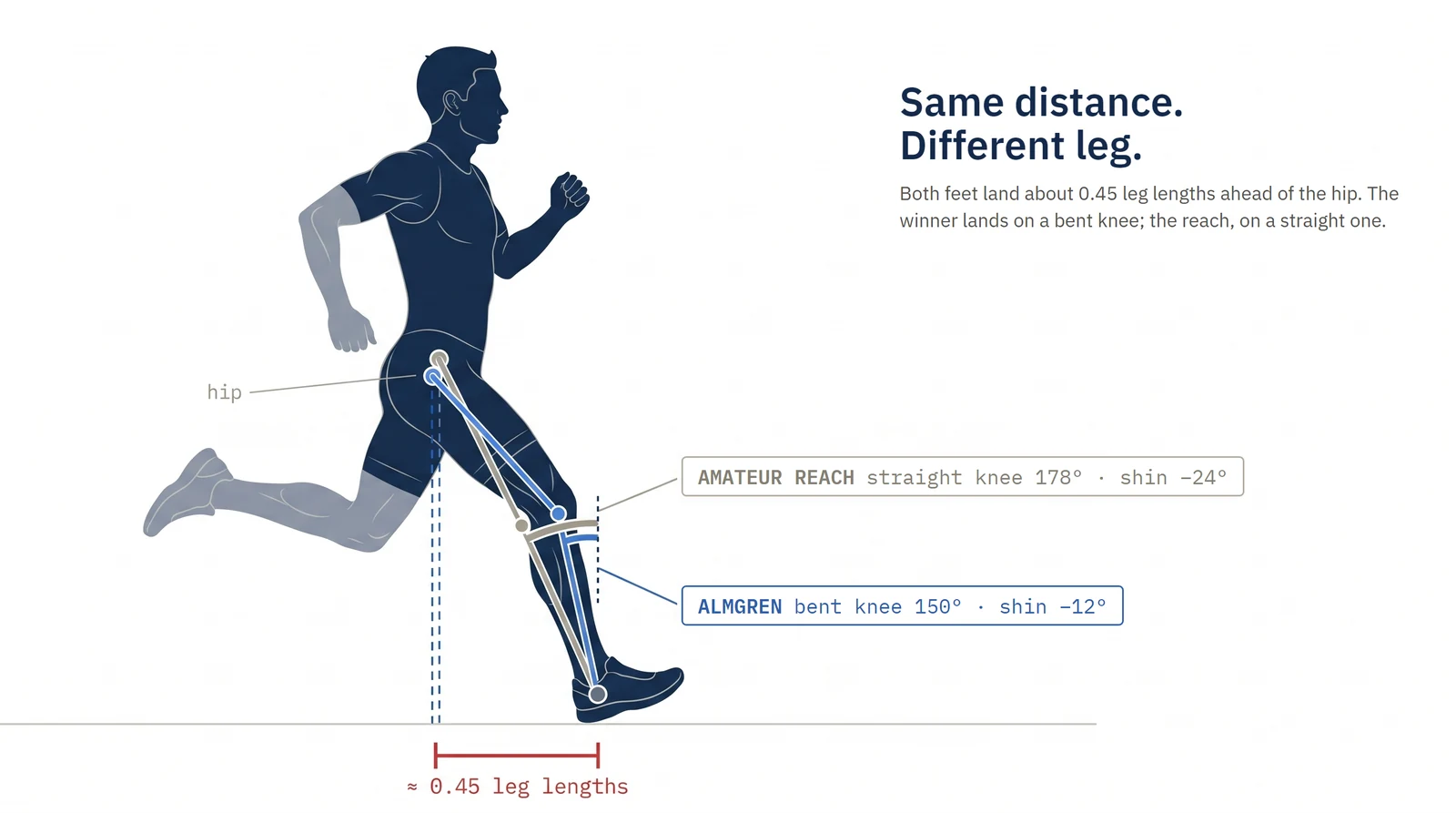
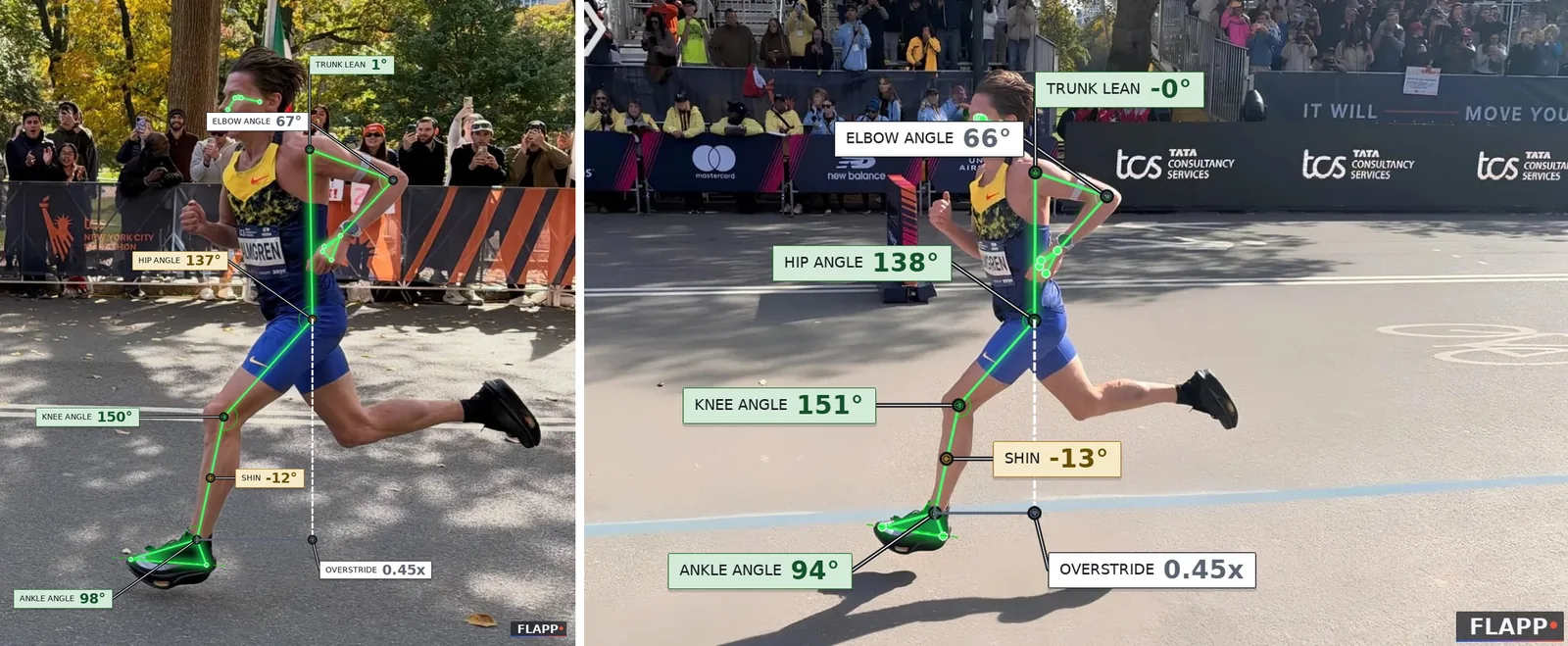
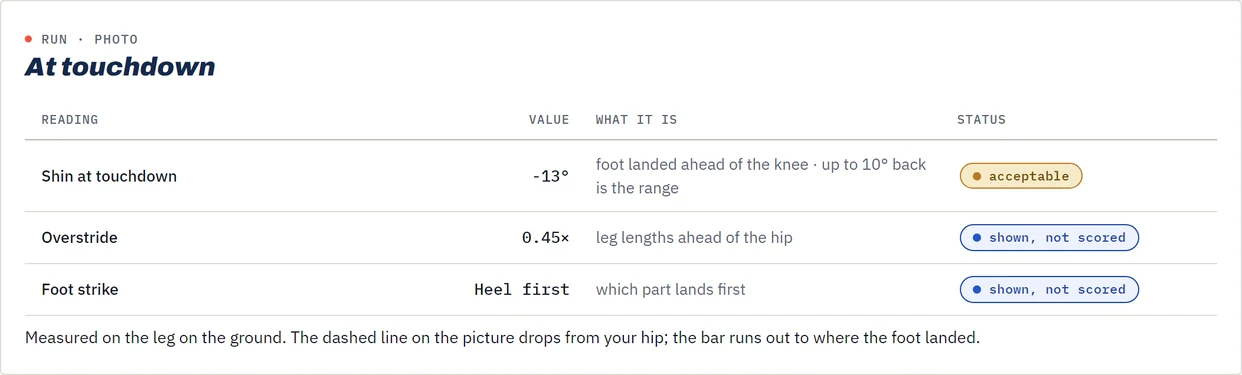
Andreas Almgren won New York on Sunday in his first marathon, in 2:06:01. In both frames we measured, his foot lands 0.45 leg lengths ahead of his hip. By the textbook, that's overstriding. At his speed, it's a long stride.
We ran the race photos through Flapp, our running-form app:
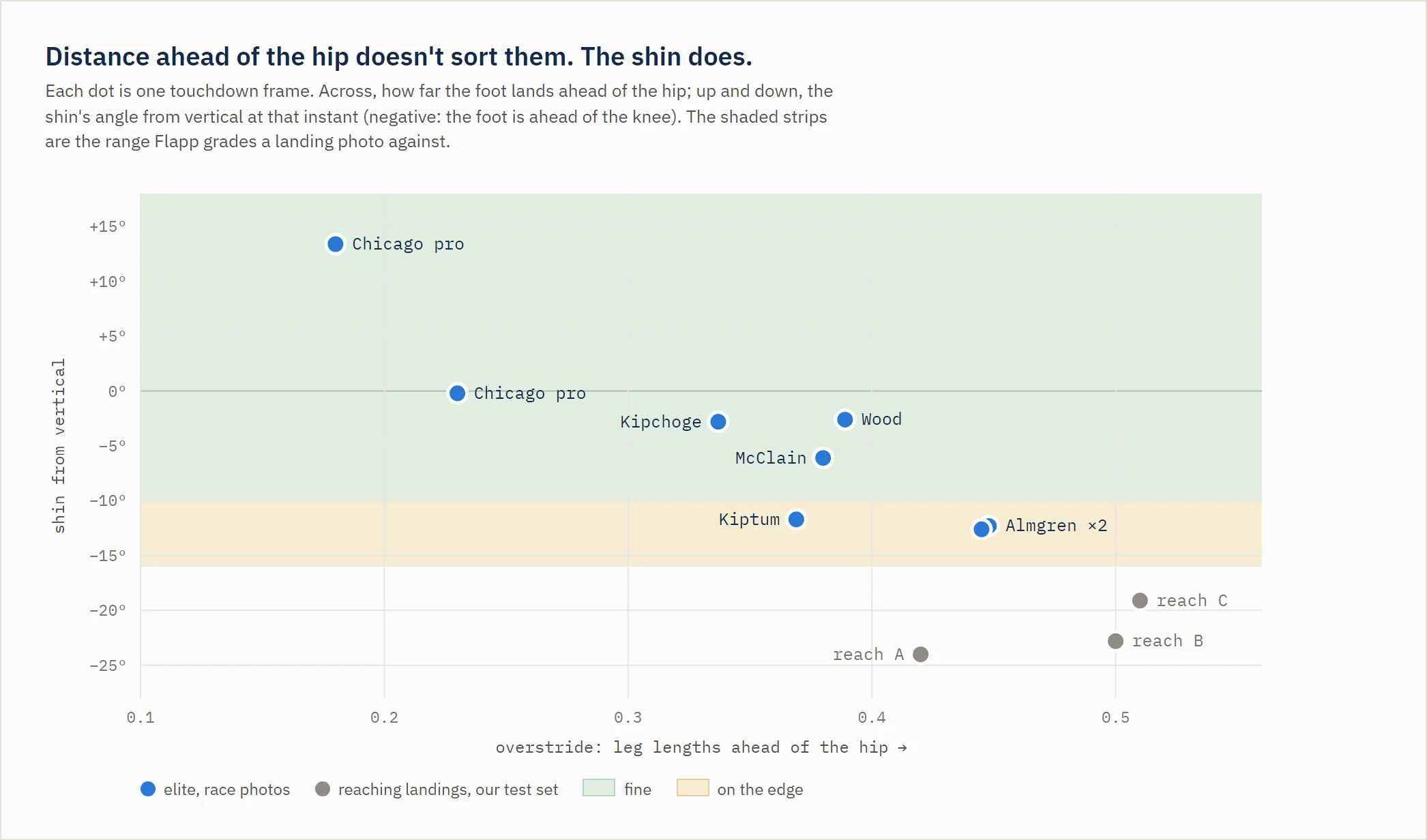
- Elite runners land 0.18–0.45 leg lengths ahead of the hip. Almgren is at the far end. For a 90 cm leg, 0.45 is about 40 cm.
- Their shins stay within 13° of vertical, knee bent. Every one of them.
- Amateur reaches in our test photos land just as far ahead, 0.42–0.51, but on a nearly straight leg with the shin tipped back 19–24°.
Same distance, different leg
"Land under your hips" works at an easy pace, not a fast one. Up to about 7 m/s you go faster mostly by lengthening the stride (Dorn 2012), so the foot lands further ahead. Almgren averaged 5.6 m/s.
Lieberman's study separates two things. The further the foot lands ahead of the hip, the more it brakes: Almgren pays that, like every fast runner. The further it lands ahead of the knee, the shin tipped back, the sharper the impact: that's the reach. A bent knee lets the thigh muscles take the landing over a few centimetres; a straight leg tipped back is a strut, and the load arrives at once. The authors' advice: land with "a relatively vertical tibia."
| Touchdown | Overstride | Shin | Knee |
|---|---|---|---|
| Almgren, NYC 2026 (2 frames) | 0.45 | −12.3°, −12.6° | 150°, 151° |
| Paige Wood, NYC 2026 | 0.39 | −3° | 137° |
| McClain, NYC 2026 ¹ | 0.38 | −6° | 145° |
| Eliud Kipchoge, NYC 2025 | 0.34 | −3° | 144° |
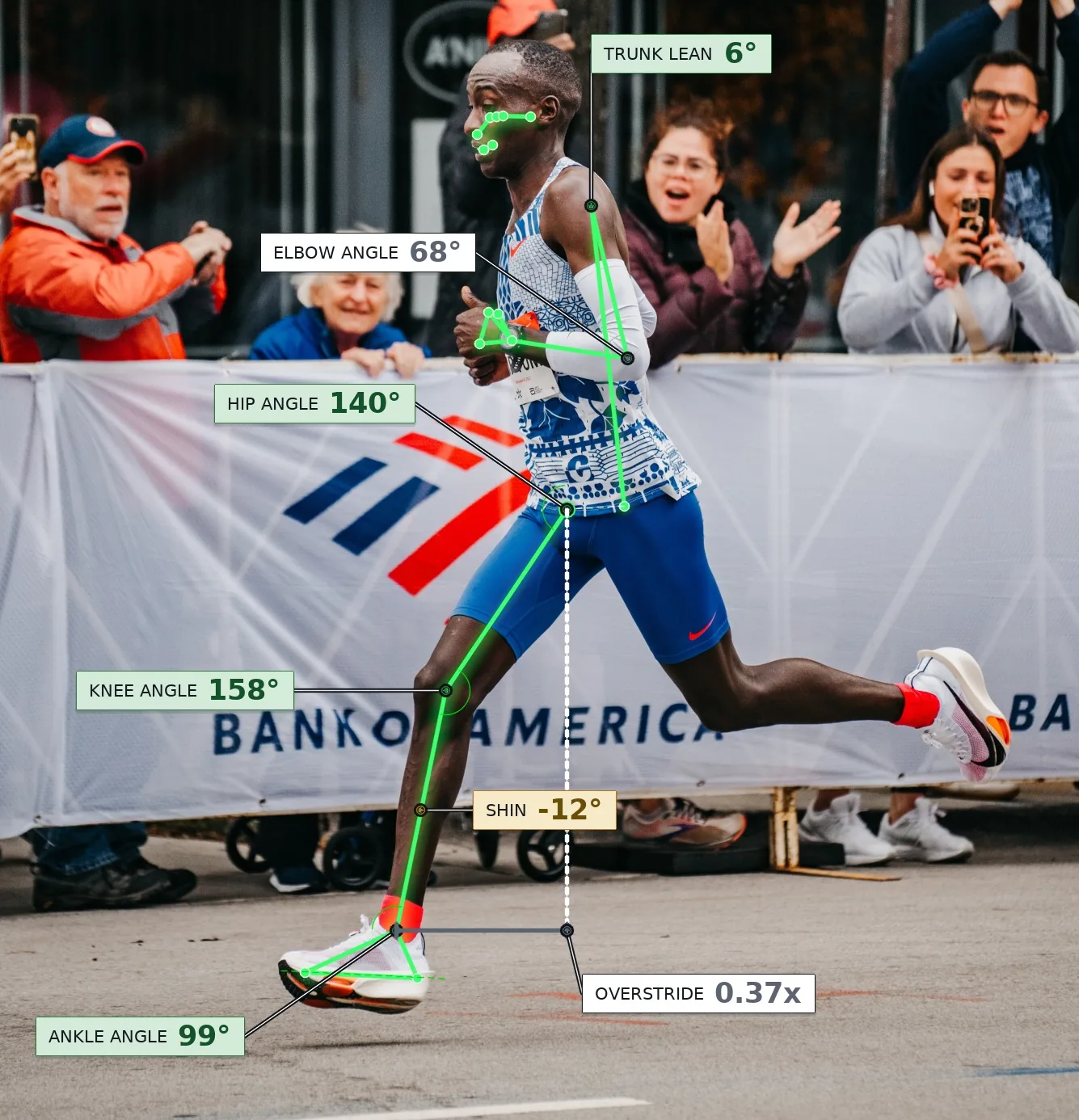
| Kiptum, Chicago 2023 | 0.37 | −12° | 158° |
| Pros, Chicago 2026 ² | 0.23, 0.18 | 0°, +13° | 153°, 131° |
| Amateur reaches, our test set | 0.42–0.51 | −19° to −24° | 157–178° |
Overstride in leg lengths ahead of the hip. Shin: negative means the foot landed ahead of the knee. ¹ Shot from three-quarters in front, which shortens the overstride. ² Not identified.
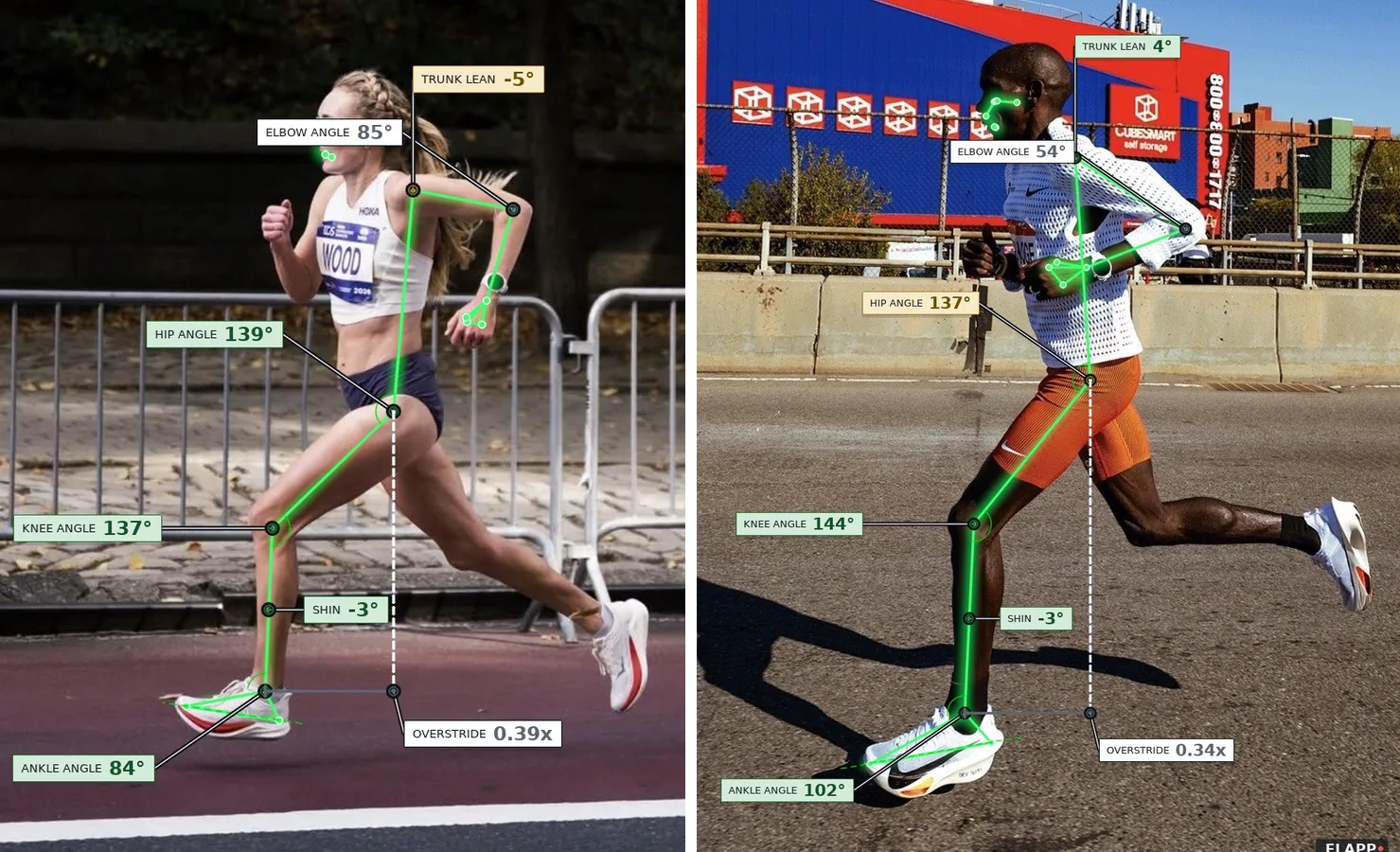
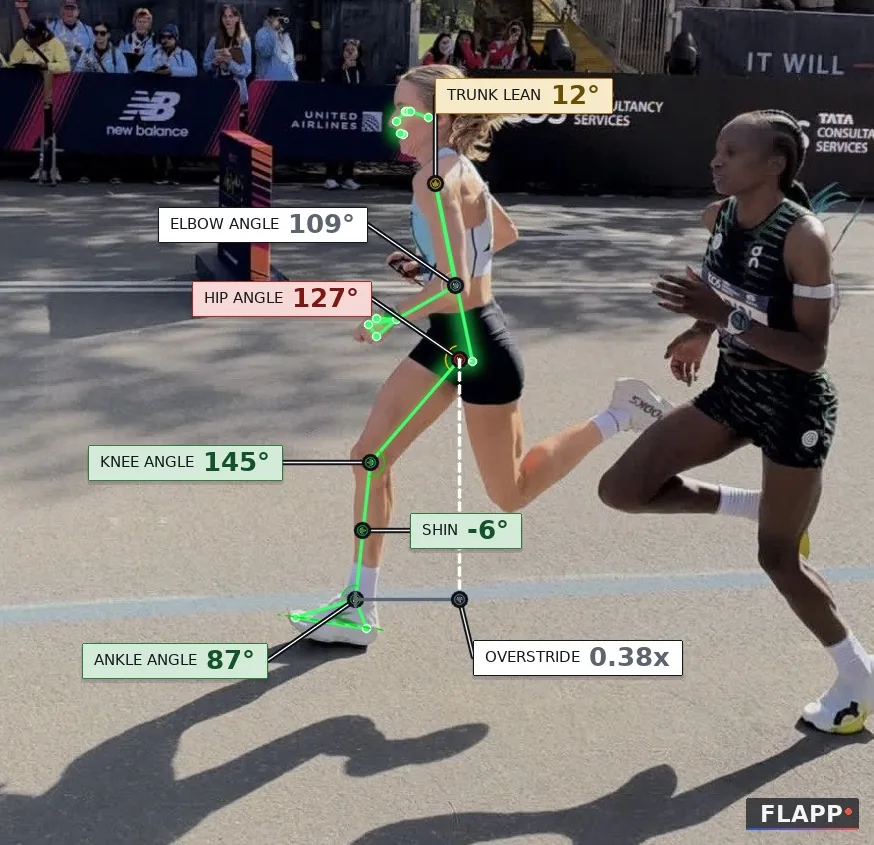
Two frames, one number
Almgren's two frames come from different photographers at different spots and agree within a degree: overstride 0.448 and 0.445, shin −12.3° and −12.6°. Either he lands the same way every stride, or both caught the same step. Either way, two cameras gave one answer.
Our band calls him "on the edge"
Flapp treats a shin within 10° of vertical as fine. Almgren (−12.3°, −12.6°) and Kiptum (−11.7°) come out amber. The band was set at everyday paces; at 5.6 m/s a little more lean may be normal. Eight elite frames aren't enough to move it.
Heel or midfoot?
Flapp read one Almgren frame as midfoot and the other as heel, with knee, hip and shin matching within 1.5°. From a single frame, foot strike is a coin toss. Most marathoners at the 2017 World Championships landed heel first anyway (Hanley 2019). The heel isn't the problem. The shin might be.
Check your own
Film or photograph yourself side-on at the instant your foot lands:
- Shin within ~10° of vertical, knee bent: you land like the elites, however far ahead of the hip.
- Shin back 15° or more, knee nearly straight: that's the reach. Try a slightly quicker cadence (see overstriding).
How we measured
Flapp's pose model finds the hip, knee, ankle, heel and toe. At touchdown it measures the hip-to-ankle distance in leg lengths, the shin's angle and the knee; a far landing leg is measured from its own hip. We used only side-on frames at the instant of landing. Chepkirui, Obiri and Kipruto were only in flight or at push-off in our photos, so they're out. Eleven frames: examples, not a study.
Sources
- Lieberman, D. E., Warrener, A. G., Wang, J. & Castillo, E. R. (2015). Effects of stride frequency and foot position at landing on braking force, hip torque, impact peak force and the metabolic cost of running in humans (Journal of Experimental Biology, 218, 3406–3414)Fourteen runners at 3.0 m/s: landing further ahead of the hip went with larger braking forces; landing further ahead of the knee, with higher impact peaks and loading rates. The authors suggest landing at the end of swing with a relatively vertical tibia.
- Dorn, T. W., Schache, A. G. & Pandy, M. G. (2012). Muscular strategy shift in human running: dependence of running speed on hip and ankle muscle performance (Journal of Experimental Biology, 215, 1944–1956)Up to about 7 m/s, runners go faster mainly by lengthening the stride; only above that does stride frequency take over.
- Hanley, B., Bissas, A., Merlino, S. & Gruber, A. H. (2019). Most marathon runners at the 2017 IAAF World Championships were rearfoot strikers, and most did not change footstrike pattern (Journal of Biomechanics, 92, 54–60)Rearfoot striking was the most common pattern in both world-championship marathons (never under 54% of the men or 67% of the women); forefoot striking was rare.
Want this checked on your own form? Upload a side-view clip.
Analyze my video